

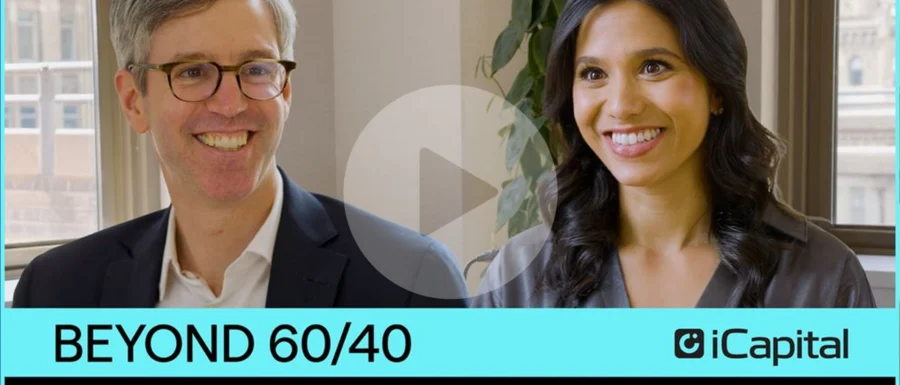
Beyond 60/40 Video: Episode 51 Private Credit Myths, Defaults, and Liquidity Reality In Episode 51 of Beyond 60/40, iCapital Chief Investment Strategist Sonali Basak sits down with Sam Williams,…
The Next Evolution in Defined Contribution Plans
The Future of Retirement Investing Starts Here
Defined Contribution (DC) plans in the United States hold more than $13 trillion in assets.1 As access to alternative investments (private markets) grows, DC portfolios are adapting. When delivered through professionally managed, diversified structures, these exposures may support more resilient retirement outcomes for participants.

Advantages of Including Alternatives in DC Plans
DC plans offer structural advantages that make the inclusion of private markets both practical and beneficial for participants.
Professional Asset Allocation
Alternatives can be incorporated through familiar vehicles such as professionally managed accounts and target date funds (TDFs). These vehicles provide expert allocation that calibrates exposure, rebalances portfolios, and derisks over time, helping participants stay aligned with long-term goals.
Long-Term Investment Horizons
Retirement plans are designed for decades of saving. Their scale, regular contribution schedule, and tax-deferred status create an environment where alternatives can be implemented efficiently under fiduciary oversight, supporting participant outcomes over the long-term.
Diversification to Improve Retirement Outcomes
Adding private markets diversifies beyond stocks and bonds. When delivered through professionally managed portfolios, these exposures may improve risk‑adjusted returns, reduce reliance on public markets, and support more resilient retirement outcomes.
iCapital helps translate those advantages into practice. Our teams partner with asset managers, consultants, recordkeepers, and plan sponsors to design DC‑ready allocations, ensure liquidity and valuation standards, and integrate these options seamlessly into existing plan menus—removing friction for every stakeholder.
iCapital: The Connector Across the DC Ecosystem
Bringing alternatives into retirement plans is not a single‑product or single‑platform decision—it’s a coordinated effort across the ecosystem. iCapital acts as the trusted connector, orchestrating stakeholders and simplifying the path from idea to adoption.
Education & Enablement
Role‑specific education for fiduciaries, advisors/consultants, and participants—paired with ongoing due diligence—builds confidence and supports prudent decision‑making.
Technology & Operations
End‑to‑end operating platform that streamlines fund onboarding, lifecycle management, reporting, and recordkeeper/administrator integration, making adoption repeatable at scale.
Portfolio Design & Management
Expertise in allocation design, liquidity/valuation practices, and DC‑specific portfolio construction ensures alternatives are integrated responsibly and aligned with ERISA standards.
Governance & Compliance
Structured oversight, documentation, and communications to support a defensible fiduciary process for sponsors and their advisors—reducing operational friction and perceived litigation risk.
Let’s Build What’s Next – Together
iCapital is committed to helping the industry evolve. Whether you’re an asset manager, plan advisor, recordkeeper, or sponsor, we’re here to help you deliver stronger outcomes for participants—and a more resilient retirement system.
Connect with our team to learn more
Featured Articles

In this report, we analyze responses from iCapital’s latest Private Markets Survey for Canada. The survey, conducted in October 2025, was developed for Canadian Wealth Managers, Multi-Family Offices (MFOs) and…

For decades, performance reporting functioned primarily as a record of the past, designed to meet oversight requirements rather than inform future decisions. That model is no longer sufficient. As portfolios…
1. Variable annuities are subject to market risk and do not provide any form of principal protection. All guarantees and protections are subject to the claims-paying ability of the issuing insurance company.
IMPORTANT INFORMATION
The material herein has been provided to you for informational purposes only by Institutional Capital Network, Inc. (“iCapital Network”) or one of its affiliates (iCapital Network together with its affiliates, “iCapital”). This material is the property of iCapital and may not be shared without the written permission of iCapital. No part of this material may be reproduced in any form, or referred to in any other publication, without express written permission of iCapital.
This material is provided for informational purposes only and is not intended as, and may not be relied on in any manner as, legal, tax or investment advice, a recommendation, or as an offer or solicitation to buy or sell any security, financial product or instrument, or otherwise to participate in any particular trading strategy. This material does not intend to address the financial objectives, situation, or specific needs of any individual investor. You should consult your personal accounting, tax and legal advisors to understand the implications of any investment specific to your personal financial situation.
ALTERNATIVE INVESTMENTS ARE CONSIDERED COMPLEX PRODUCTS AND MAY NOT BE SUITABLE FOR ALL INVESTORS. Prospective investors should be aware that an investment in an alternative investment is speculative and involves a high degree of risk. Alternative Investments often engage in leveraging and other speculative investment practices that may increase the risk of investment loss; can be highly illiquid; may not be required to provide periodic pricing or valuation information to investors; may involve complex tax structures and delays in distributing important tax information; are not subject to the same regulatory requirements as mutual funds; and often charge high fees. There is no guarantee that an alternative investment will implement its investment strategy and/or achieve its objectives, generate profits, or avoid loss. An investment should only be considered by sophisticated investors who can afford to lose all or a substantial amount of their investment.
iCapital Markets LLC operates a platform that makes available financial products to financial professionals. In operating this platform, iCapital Markets LLC generally earns revenue based on the volume of transactions that take place in these products and would benefit by an increase in sales for these products.
The information contained herein is an opinion only, as of the date indicated, and should not be relied upon as the only important information available. Any prediction, projection or forecast on the economy, stock market, bond market or the economic trends of the markets is not necessarily indicative of the future or likely performance. The information contained herein is subject to change, incomplete, and may include information and/or data obtained from third party sources that iCapital believes, but does not guarantee, to be accurate. iCapital considers this third-party data reliable, but does not represent that it is accurate, complete and/or up to date, and it should not be relied on as such. iCapital makes no representation as to the accuracy or completeness of this material and accepts no liability for losses arising from the use of the material presented. No representation or warranty is made by iCapital as to the reasonableness or completeness of such forward-looking statements or to any other financial information contained herein.
Securities products and services are offered by iCapital Market LLC, an SEC-registered broker-dealer, member FINRA and SIPC, and an affiliate of iCapital, Inc. and Institutional Capital Network, Inc. These registrations and memberships in no way imply that the SEC, FINRA, or SIPC have endorsed any of the entities, products, or services discussed herein. Annuities and insurance services are provided by iCapital Annuities and Insurance Services LLC, an affiliate of iCapital, Inc. “iCapital” and “iCapital Network” are registered trademarks of Institutional Capital Network, Inc. Additional information is available upon request.
© 2025 Institutional Capital Network, Inc. All Rights Reserved.