

For decades, performance reporting functioned primarily as a record of the past, designed to meet oversight requirements rather than inform future decisions. That model is no longer sufficient. As portfolios grow more complex, alternatives become core, and investor expectations rise, reporting is undergoing a fundamental shift.
Today, reporting plays a more strategic role – enabling better decisions, faster action, and scalable growth across an increasingly fragmented landscape. This evolution, from manual, disconnected systems to automated, insight‑driven reporting, marks a turning point. Reporting is no longer just operational infrastructure – it is emerging as a source of durable competitive advantage.
At iCapital, we see this shift firsthand. Working at the intersection of private markets data, reporting, and advisor infrastructure, we support RIAs, family offices, and private banks as they manage increasingly complex portfolios. Across these firms, reporting has emerged as one of the most persistent constraints on growth—consuming advisor time, limiting visibility, and slowing decision making just as alternatives become core.
The Legacy Reality: Reporting as Friction, Not Value
Across the wealth management channel, legacy reporting environments share a familiar set of challenges.
Industry research shows that many wealth management firms still rely on manual data extraction and spreadsheet‑based reporting. Roughly 40–45% of family offices continue to aggregate data by hand across PDFs, portals, custodians, and fund administrators.1 Data arrives in inconsistent formats, reconciliation is constant, and teams spend a disproportionate amount of time assembling reports rather than using them. In this legacy state, reporting is:
- Manual and fragmented, with no single source of truth
- Dependent on spreadsheets
- Reactive reporting limited to basic performance metrics – little insight into risk, liquidity, or exposure
The operational toll is substantial. According to iCapital’s Global Advisor Survey2, wealth management teams spend nearly 48 hours per week across all team members on fund and investment lifecycle activity. Client reporting consistently ranks among the top barriers to advisor efficiency and alternative investment adoption.
That data point matters. The challenge isn’t lack of interest in alternatives or sophisticated portfolio construction – it’s that reporting complexity consumes the time, focus, and operational capacity required to deliver them effectively.
As Jeremy Langlois, Managing Director of Data and Reporting at iCapital, has observed,
When advisors spend more time preparing information than discussing it, something fundamental breaks.
Rising Complexity Is Forcing Transformation
Family offices, RIAs, and private banks are managing broader asset mixes, higher alternatives allocations, more bespoke ownership structures, and increasingly global footprints. At the same time, firms are professionalizing, moving from founder-centric operations toward institutional operating models designed to scale.
This creates pressure on reporting in several ways:
- Fragmented systems limit visibility across total wealth
- Customization demands strain internal teams
- Talent turnover introduces operational and continuity risk
- Delayed insights slow decision-making at precisely the moment agility matters most
Reporting is no longer a back-office concern. It’s a frontline strategic dependency—directly affecting advisor capacity, client experience, and growth.
The Maturity Shift: From Centralized to Strategic Reporting
Many firms have made progress by centralizing reporting, through internal platforms or third‑party tools, improving consistency and visibility. But centralization doesn’t eliminate the ongoing operational lift required to keep reporting accurate and tailored as complexity grows.
Even centralized reporting demands ongoing oversight. Teams still manage data exceptions, coordinate vendors, maintain custom views, reconcile inconsistencies, and adapt reports as portfolios evolve. Customization is possible but it often comes at the cost of time, effort, and scalability.
As asset mixes grow more complex and alternatives become core, those demands begin to snowball. What starts as a centralized solution can quickly become a familiar challenge: rising operational lift, reliance on key individuals, and reporting that struggles to keep pace. This is where centralized reporting reaches its limits and the shift to strategic reporting begins.
Strategic Reporting: From Operational Burden to Growth Infrastructure
The goal is not better reports, but better decisions—delivered faster, without increasing operational load.
Strategic reporting is the next stage of maturity – designed to support scale, not just consolidate data. It combines automated data ingestion, AI‑powered extraction for illiquid assets, human verification, and a standardized data model that feeds the broader ecosystem.
The result isn’t just cleaner reports. It’s a reporting foundation built to absorb complexity without multiplying effort, enabling a unified view across asset classes, faster and more confident decisions, consistent client experiences, and continuity that doesn’t hinge on individual staff members.
As Jeremy Langlois notes, “This isn’t just a technology upgrade—it’s a strategic one.” Firms that make the shift gain a quiet but durable advantage: RIAs differentiate through insight‑led conversations, family offices scale without fragility, and private banks grow without disrupting core workflows. When advisors can credibly consolidate a client’s full financial picture, conversations move beyond reporting and trust, and mandates, follow.
From Hours to Minutes: Proof in Practice
Jeremy Langlois often points to a simple but telling example from one of his clients located in Asia to illustrate what the shift to strategic reporting looks like in practice.
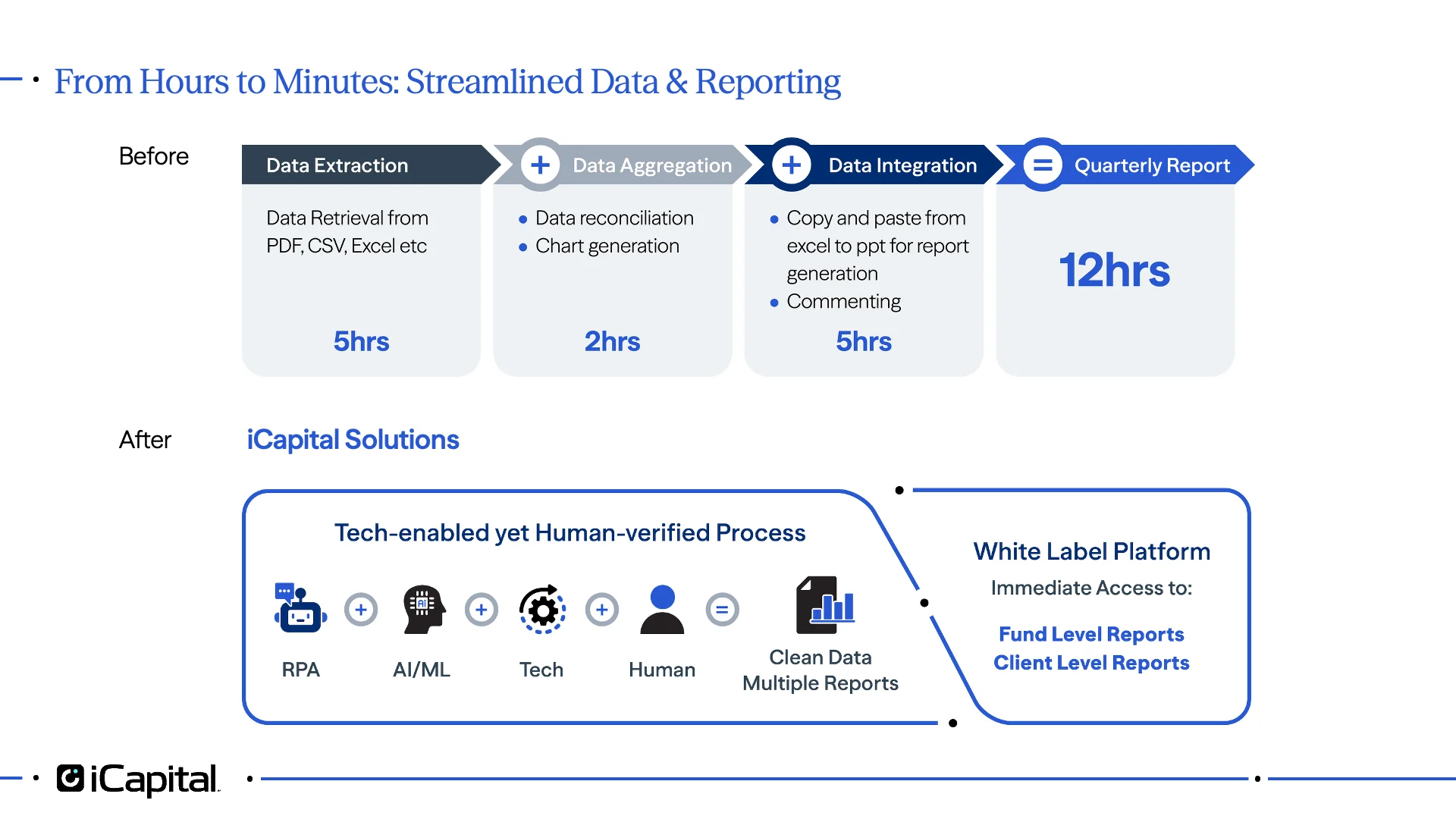
In this case, a wealth organization managing complex alternative portfolios was spending approximately 12 hours to produce a single quarterly report for one fund. That time wasn’t spent on insight or client strategy—it was consumed by manual work: pulling data from PDFs and portals, reconciling inconsistencies, rebuilding charts, and assembling reports by hand. What changed wasn’t just the tooling. It was the reporting model.
By moving to a tech‑enabled, human‑verified strategic reporting approach—combining automated data extraction, centralized data management, and expert oversight—the same workflow was reduced from hours to minutes. Data was automatically retrieved and extracted from PDFs, spreadsheets, and portals, standardized and validated, and delivered directly into reporting platforms, making fund‑level and client‑level views immediately accessible across systems, without incremental effort.
As Jeremy has emphasized,
The real impact wasn’t speed alone. Reporting stopped being an operational bottleneck and started functioning as infrastructure. The firm gained consistency across clients and regions, confidence in its data, and the ability to scale without adding headcount”.
 The Artificial Intelligence Accelerant

Artificial intelligence is a critical enabler of strategic reporting at scale—not by replacing advisors or investment judgment, but by eliminating the manual, repetitive work that has historically constrained consolidated reporting.
AI-powered extraction and normalization reduce the manual burden of parsing PDFs, reconciling exceptions, and standardizing illiquid data. As those frictions fade, expectations shift towards always current, centralized reporting across asset classes.
In this context, AI doesn’t simply enhance reporting—it accelerates the transition from centralized solutions to strategic, always‑on reporting infrastructure built to support insight, scale, and continuity.
The Strategic Imperative
The evolution of reporting mirrors the evolution of wealth management itself — from reactive to proactive, fragmented to integrated, manual to intelligent.
Over the next three to five years, this shift will quietly separate leaders from everyone else. Firms that invest now will build scalable infrastructure, healthier teams, and faster client experiences. Those that delay will face compounding integration debt, rising unit costs, and advisor burnout.
Reporting is no longer an operational obligation. It’s a strategic advantage —one iCapital sees shaping how firms scale, serve clients, and make decisions in increasingly complex portfolios.
ENDNOTES
- Source: iCapital Global Advisor Survey, June 2025. See Important Information slide for further details on the Global Advisor Survey.
- Source: The Family Office Insights Series: Defining the Family Office Landscape, 2024.
IMPORTANT INFORMATION
The material herein has been provided to you for informational purposes only by Institutional Capital Network, Inc. (“iCapital Network”) or one of its affiliates (iCapital Network together with its affiliates, “iCapital”). This material is the property of iCapital and may not be shared without the written permission of iCapital. No part of this material may be reproduced in any form, or referred to in any other publication, without express written permission of iCapital.
This material is provided for informational purposes only and is not intended as, and may not be relied on in any manner as, legal, tax or investment advice, a recommendation, or as an offer or solicitation to buy or sell any security, financial product or instrument, or otherwise to participate in any particular trading strategy. This material does not intend to address the financial objectives, situation, or specific needs of any individual investor. You should consult your personal accounting, tax and legal advisors to understand the implications of any investment specific to your personal financial situation.
ALTERNATIVE INVESTMENTS ARE CONSIDERED COMPLEX PRODUCTS AND MAY NOT BE SUITABLE FOR ALL INVESTORS. Prospective investors should be aware that an investment in an alternative investment is speculative and involves a high degree of risk. Alternative Investments often engage in leveraging and other speculative investment practices that may increase the risk of investment loss; can be highly illiquid; may not be required to provide periodic pricing or valuation information to investors; may involve complex tax structures and delays in distributing important tax information; are not subject to the same regulatory requirements as mutual funds; and often charge high fees. There is no guarantee that an alternative investment will implement its investment strategy and/or achieve its objectives, generate profits, or avoid loss. An investment should only be considered by sophisticated investors who can afford to lose all or a substantial amount of their investment.
iCapital Markets LLC operates a platform that makes available financial products to financial professionals. In operating this platform, iCapital Markets LLC generally earns revenue based on the volume of transactions that take place in these products and would benefit by an increase in sales for these products.
The information contained herein is an opinion only, as of the date indicated, and should not be relied upon as the only important information available. Any prediction, projection or forecast on the economy, stock market, bond market or the economic trends of the markets is not necessarily indicative of the future or likely performance. The information contained herein is subject to change, incomplete, and may include information and/or data obtained from third party sources that iCapital believes, but does not guarantee, to be accurate. iCapital considers this third-party data reliable, but does not represent that it is accurate, complete and/or up to dateiCapital makes no representation as to the accuracy or completeness of this material and accepts no liability for losses arising from the use of the material presented. No representation or warranty is made by iCapital as to the reasonableness or completeness of such forward-looking statements or to any other financial information contained herein.
Securities products and services are offered by iCapital Markets LLC, an SEC-registered broker-dealer, member FINRA and SIPC, and an affiliate of iCapital, Inc. and Institutional Capital Network, Inc. These registrations and memberships in no way imply that the SEC, FINRA, or SIPC have endorsed any of the entities, products, or services discussed herein. Annuities and insurance services are provided by iCapital Annuities and Insurance Services LLC, an affiliate of iCapital, Inc. “iCapital” and “iCapital Network” are registered trademarks of Institutional Capital Network, Inc. Additional information is available upon request.
Awards, rankings and/or recognition by unaffiliated rating services and/or publications should not be construed by a client or prospective client as a guarantee that he or she will experience a certain level of results if Institutional Capital Network Inc. (“iCapital”) is engaged, nor should it be construed as a current or past endorsement of iCapital by any of its clients.
Testimonial may not be representative of the experience of other customers. Testimonial is not a guarantee of future performance or success.
iCapital sponsored research completed first quarter 2025. A third-party research firm conducted a telephone survey of 603 financial professionals across a mix of channels, including private wealth, national and regional broker dealers (BDs), independent BDs and RIAs. We had 603 respondents across the U.S., Europe, Middle East, and APAC, covering nine countries. Additional information available upon request
© 2026 Institutional Capital Network, Inc. All Rights Reserved.