


Key Takeaways:
- Growth remains broad-based, with synchronized expansion across consumers, business investment, and profits—pushing key indicators to multi‑year highs despite geopolitical disruptions.
- Inflation is proving sticky, keeping rates higher for longer, with the 10-year Treasury now expected to remain in a 4.0%-4.8% range, creating a more challenging macro backdrop.
- Three key risks are emerging: (1) “AI capex vigilantes” as investors demand returns on heavy AI spending, (2) fading cyclical tailwinds (liquidity, fiscal support, consumer boosts), and (3) persistent upward pressure on interest rates.
- Investment stance: stay invested but more selective and risk-aware—maintain equity exposure with hedging, favor real assets in private markets for inflation resilience, and avoid extreme duration positioning in fixed income.
The U.S. macroeconomic backdrop remains notably stronger than anticipated, even in the face of one of the biggest oil supply disruptions on record. What is particularly striking is not just the level of growth, which is generally breaking out to four-year highs, but that it is also broad-based, spanning retail spending, business investment and corporate profits.
At the same time, this strength is creating a more complicated macro regime. Rather than normalizing toward the Fed’s 2% inflation target, inflation has been elevated since 2024, even before the military conflict in Iran. This is likely to keep interest rates higher for longer, particularly at the long end of the curve, where we are raising our 10-year Treasury yield expected range to 4.0%-4.8% from 3.8%-4.5%.
A broad-based breakout
Following the 2021-2022 post-pandemic boom, the U.S. economy didn’t face a singular crash. Instead, it navigated a sequence of rolling downturns as it digested the “triple threat” of high inflation, restrictive interest rates, and the withdrawal of fiscal stimulus that hit technology, then consumer goods and manufacturing.
For a time, this underlying friction was masked. A remarkably resilient consumer base—albeit with increasing signs of weakness among lower income consumers—and a tech sector that successfully passed the baton from pandemic-era growth to an AI-driven capital expenditure cycle kept the broader economy stable.
The Great Synchronization
We are shifting from fragmented resilience to a synchronized rebound. Boosted by improved liquidity and a fresh wave of investment, multiple segments of the economy are finally pulling in the same direction. This in part has been evidenced through robust corporate profits that have been largely broad-based, with small cap companies beginning to experience an earnings rebound and the S&P SmallCap 600 Index beginning to see EPS rise back to late 2024 levels. Several key indicators are currently breaking out to levels we haven’t seen in years:
- Manufacturing Purchasing Manager Indices: The US ISM Manufacturing Index surged into expansionary territory this year and sits at a four-year high, echoed in the Global Manufacturing PMI [Exhibit 1].
- Retail Sales: The Johnson Redbook weekly retail same-store sales growth is running at 7.8%, also the highest level since the end of 2022 [Exhibit 2].
- Labor Market: Even with demographic and immigration headwinds, the employment diffusion measure of labor market breadth just hit a two-year high.
 What would start to worry us
While fundamentals are undeniably strong and supportive of the bull market, the margin for error is narrowing given valuations and liquidity have surged past pre-war levels. As we move into the second half of the year, we have identified three key risks to growth and liquidity that could shift our outlook to a more cautious stance:
1. The potential for AI capex vigilantes
Through April, tech companies have raised record amounts in the bond, private credit and equity markets to finance a historic capex cycle. We recently wrote about this dynamic in our market pulse, “AI’s Price Tag is Rising,” noting that sustained capex spend will be contingent on clear evidence of operating leverage. While we believe capital will continue to be abundant, we are cognizant that investors will pull back in pockets of the industry if they believe funds are being deployed without clear, sustained returns.
In an indication of the shifting nature of liquidity, investors are now more discerning when it comes to rewarding the surging capex in AI-driven capital expenditures, particularly as it weighs heavily on free cash flow – a metric that is forecast to plummet at the largest hyperscalers [Exhibit 3].
On the back of recent earnings, we saw the market reward companies that are posting greater cloud adoption and token usage. This has led to divergent performance of the hyperscalers, with Alphabet and Amazon demonstrating the clearest benefit to their cloud growth, while Meta’s stock declined 9% on the back of raised capex guidance and unclear revenue payoff [Exhibit 4]. Importantly, we see the performance of the Philadelphia Semiconductor Index, which has risen more than 65% this year through the first week of May, as a signal that investors are still seeking to stay close to the AI infrastructure play, while displaying caution about how such infrastructure would start to benefit enterprise clients.1
Weakness in the conversion of capex into revenue and changes to the competitive landscape can reshape which companies are perceived as AI winners and losers, which can in turn change how much and where capital is allocated:
 2. Fading tailwinds
As we enter the second half of the year, some of the first half tailwinds could become headwinds as their impact fades. To the extent that the market has extrapolated the strong momentum in growth, with the biggest upgrade to annual S&P 500 EPS forecasts since the end of the pandemic [Exhibit 1], the greater the risk that growth could fall short of expectations.2 Here are some of the tailwinds that may begin to fade as the year progresses:
- Fed balance sheet: After reducing its balance sheet by 27% during the latest round of quantitative tightening, the Fed began expanding its balance sheet in December through reserve management purchases (RMPs), which involve supporting banking liquidity through purchases of Treasury bills.3 However, these purchases have only resulted in a 3% boost to the balance sheet so far, and the pace of purchases has moderated a bit in recent weeks.4
- Fiscal mortgage market support: In January, President Trump directed Fannie Mae and Freddie Mac to purchase up to $200bn (roughly 2% of the market) of agency mortgage-backed securities (MBS), in order to lower mortgage rates.5 However, in recent months, the trend has partially reversed, with MBS interest rates rising both on an absolute basis and relative to Treasury yields.
- World Cup: With the US hosting the FIFA World Cup for the first time in 32 years, related spending could provide a short-term boost to growth, but that boost would be short-lived after the event wraps up in late July.
- Energy prices: At the end of 2025, falling average gasoline prices fell below $3.00/gallon for the first time since the pandemic, providing a further boost to households and corporate margins.6 However, in the wake of the Iran war, gasoline prices have surged past $4.50/gallon and fast approaching the $5.02/gallon record levels hit in 2022.7 While households are not as sensitive to energy prices as they used to be, further increases will likely begin to eat into demand for other areas of spending, many of which are experiencing their own inflationary pressures.
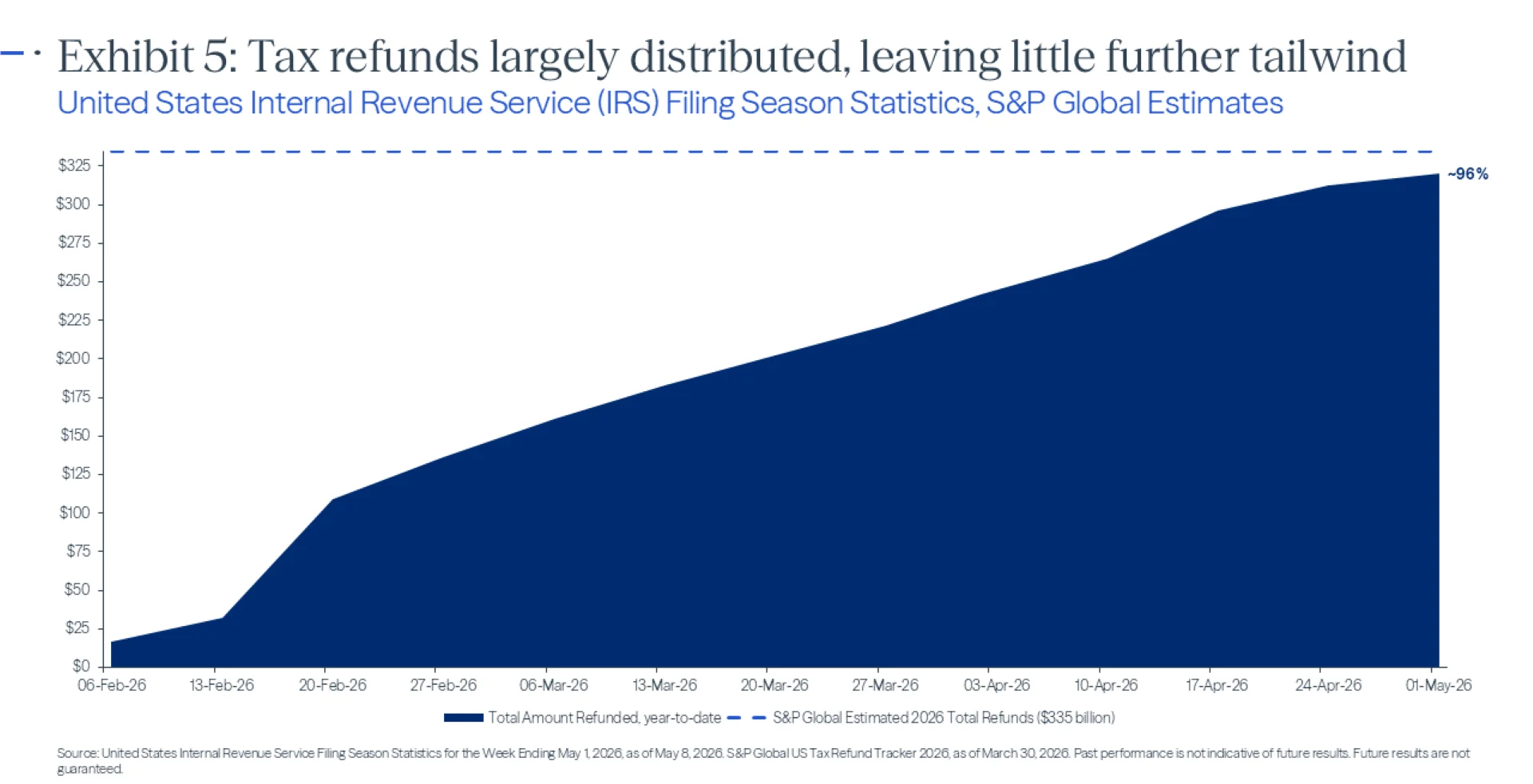
- Tax refunds: The record tax refund season is winding down. As of May 1st, the average refund of $3,273 was up 11% vs the prior year, providing a nice offset to higher gasoline prices.8 However, with most of those refunds having been distributed, this tailwind is likely to be short-lived.
 3. Higher for longer interest rates
Interest rates remain a key risk to liquidity and growth, largely driven by the stickiness of high inflation and the dual threats of Iran and the potential continuation of the strong growth momentum discussed earlier:
Supply-driven inflation: If the Strait of Hormuz remains significantly disrupted for much longer, the impact on commodity prices and inflation may accelerate, as a lack of physical supply in certain markets wreaks havoc on prices and pushes interest rates higher. The longer this lasts, the stickier future inflation is likely to be.
Demand-driven inflation: Alternatively, if growth were to continue to come in above expectations, this could exacerbate inflationary pressures, regardless of what happens in the Middle East.
No matter how things play out, we think that the higher for longer inflationary backdrop has put a floor on how low interest rates can go this year. We think it unlikely that the 10-year Treasury yield will fall below 4% unless growth slows to the point where the market starts to price in a significant risk of recession. But if we see further supply- or demand-driven pressure on inflation, we think 10-year yields could approach 4.8%, a level we think would begin to weigh on markets and cause volatility to rise. We have raised our 10-year Treasury yield range from 3.8-4.5% to 4.0-4.8%.
Investment implications
Public markets: Maintain equity exposure, but consider hedging
The healthy earnings backdrop provides strong fundamental support for public equities, but the risks to liquidity and growth, particularly the binary nature of the military conflict in Iran, suggest that the potential for further gains is accompanied by elevated tail risks. As such, we recommend that clients maintain broad exposure to public equities, but those with shorter time horizons or lower risk tolerance should consider hedging their downside. Structured investments provide a way to protect against downside risk while capturing income.
Private markets
In private markets, higher inflationary pressures could reinforce the benefits of holding real assets, many of which are linked to inflation. Real assets have historically performed favorably in a variety of inflationary environments—in periods of high inflation over the past 20-plus years, real assets outperformed both public equity and public fixed income—but have especially excelled when the prices of goods and services have risen rapidly.9
Value-add and opportunistic investing remains our top idea in real estate. Net operating income (NOI) for such strategies has increased significantly faster than inflation over the last 10 years, which should enable total return strategies to outperform as real estate values stabilize.10
Interest rates: Own duration but not too much
With the 10-year Treasury yield near the middle of our new expected range of 4.0-4.8%, we see reason to be tempered in duration positioning. That said, we think risks skew to the upside given the inflationary dynamics discussed earlier. While a range of borrowers may be strained from higher-for-longer interest rates, equally lenders may be able to capture meaningful yields in private markets should investors stay high up in capital structure with sufficient protections. This could make parts of the 2026 vintage attractive for private credit.
- Bloomberg Index Services, as of May 11, 2026.
- Bloomberg Index Services, as of May 8, 2026.
- Bloomberg Index Services, as of May 11, 2026.
- Bloomberg Index Services, as of May 11, 2026.
- The White House, as of February 19, 2026.
- Bloomberg Index Services, as of May 11, 2026.
- Bloomberg Index Services, as of May 11, 2026.
- United States Internal Revenue Service Filing Season Statistics for Week Ending May 1, 2026, as of May 8, 2026.
- Bloomberg Index Services Limited, FTSE Russell, MSCI, NCREIF, Preqin, S&P Dow Jones, iCapital Alternatives Decoded, with data based on availability as of November 2025.
- NCREIF, as of December 31, 2025.
INDEX DEFINITIONS
S&P 500 Index: The S&P 500 is widely regarded as the best single gauge of large-cap U.S. equities. The index includes 500 of the top companies in leading industries of the U.S. economy and covers approximately 80% of available market capitalization.
J.P. Morgan Global Manufacturing PMI: The J.P. Morgan Global Manufacturing PMI gives an overview of the global manufacturing sector. It is based on monthly surveys of over 10,000 purchasing executives from 32 of the world’s leading economies, including the U.S., Japan, Germany, France and China which together account for an estimated 89 percent of global manufacturing output. It reflects changes in global output, employment, new orders and prices. The Global Manufacturing PMI is seasonally adjusted at the national level to control for varying seasonal patterns in each country and is produced by J.P. Morgan and Markit Economics in association with ISM and the International Federation of Purchasing and supply Management (IFPSM).
Philadelphia Semiconductor Index: The Philadelphia Stock Exchange Semiconductor IndexSM is a modified market capitalization-weighted index composed of companies primarily involved in the design, distribution, manufacture, and sale of semiconductors.
US ISM Manufacturing PMI: The ISM Purchasing Managers Index is a monthly business survey indicator produced in the United States by the Institute of Supply Management based on questionnaire responses collected from its members, which are predominantly supply chain or purchasing executives in large corporations.
Johnson Redbook Index: The Johnson Redbook Index is a sales-weighted of year-over-year same-store sales growth in a sample of large US general merchandise retailers representing about 9,000 stores. Same-store sales are sales in stores continuously open for 12 months or longer. By dollar value, the Index represents over 80% of the equivalent ‘official’ retail sales series collected and published by the US Department of Commerce. Redbook compiles the Index by collecting and interpreting performance estimates from retailers. The Index and its sub-groups are sales-weighted aggregates of these estimates. Weeks are retail weeks (Sunday to Saturday), and equally weighted within the month.
S&P SmallCap 600 Index: The S&P SmallCap 600® seeks to measure the small-cap segment of the U.S. equity market. The index is designed to track companies that meet specific inclusion criteria to ensure that they are liquid and financially viable.
Employment Diffusion Index: The Current Employment Statistics (CES) program currently publishes diffusion indexes to measure how widely national employment changes are spread across industries over 1-, 3-, 6-, and 12-month time spans. Diffusion indexes help us understand whether a change in employment may be caused by smaller employment changes in many industries or by large changes in a few industries. We calculate an overall index from 258 employment series (primarily 4-digit NAICS industries) covering all nonfarm payroll employment in the private sector. To derive the index, each industry is assigned a value of 0, 50, or 100, depending on whether its employment showed a decrease, no change, or an increase, respectively, over the time span. We then calculate the average (mean) of these values, and this percent is the diffusion index number. A diffusion index of 50 would show that the same number of component industries had increasing employment and decreasing employment, while an index higher than 50 would suggest more industries were increasing employment than decreasing over the index time span.
IMPORTANT INFORMATION
The material herein has been provided to you for informational purposes only by Institutional Capital Network, Inc. ("iCapital Network") or one of its affiliates (iCapital Network together with its affiliates, "iCapital"). This material is the property of iCapital and may not be shared without the written permission of iCapital. No part of this material may be reproduced in any form, or referred to in any other publication, without express written permission of iCapital.
This material is provided for informational purposes only and is not intended as, and may not be relied on in any manner as, legal, tax or investment advice, a recommendation, or as an offer or solicitation to buy or sell any security, financial product or instrument, or otherwise to participate in any particular trading strategy. This material does not intend to address the financial objectives, situation, or specific needs of any individual investor. You should consult your personal accounting, tax and legal advisors to understand the implications of any investment specific to your personal financial situation.
ALTERNATIVE INVESTMENTS ARE CONSIDERED COMPLEX PRODUCTS AND MAY NOT BE SUITABLE FOR ALL INVESTORS. Prospective investors should be aware that an investment in an alternative investment is speculative and involves a high degree of risk. Alternative Investments often engage in leveraging and other speculative investment practices that may increase the risk of investment loss; can be highly illiquid; may not be required to provide periodic pricing or valuation information to investors; may involve complex tax structures and delays in distributing important tax information; are not subject to the same regulatory requirements as mutual funds; and often charge high fees. There is no guarantee that an alternative investment will implement its investment strategy and/or achieve its objectives, generate profits, or avoid loss. An investment should only be considered by sophisticated investors who can afford to lose all or a substantial amount of their investment
STRUCTURED INVESTMENTS ARE CONSIDERED COMPLEX PRODUCTS AND MAY NOT BE SUITABLE FOR ALL INVESTORS. Please note that there is no public secondary market for structured investments. Although the issuer may from time to time make a market in certain structured investments, the issuer does not have any obligation to do so and market making may be discontinued at any time. Accordingly, an investor must be prepared to hold such investments until maturity. Any or all payments are subject to the creditworthiness of the issuer. Before investing in any product, an investor should review the prospectus or other offering documents, which contain important information, including the product's investment objectives or goals, its strategies for achieving those goals, the principal risks of investing in the product, the product's fees and expenses, and its past performance.
iCapital Markets LLC operates a platform that makes available financial products to financial professionals. In operating this platform, iCapital Markets LLC generally earns revenue based on the volume of transactions that take place in these products and would benefit by an increase in sales for these products.
The information contained herein is an opinion only, as of the date indicated, and should not be relied upon as the only important information available. Any prediction, projection or forecast on the economy, stock market, bond market or the economic trends of the markets is not necessarily indicative of the future or likely performance. The information contained herein is subject to change, incomplete, and may include information and/or data obtained from third party sources that iCapital believes, but does not guarantee, to be accurate. iCapital considers this third-party data reliable, but does not represent that it is accurate, complete and/or up to date. iCapital makes no representation as to the accuracy or completeness of this material and accepts no liability for losses arising from the use of the material presented. No representation or warranty is made by iCapital as to the reasonableness or completeness of such forward-looking statements or to any other financial information contained herein.
Securities products and services are offered by iCapital Markets LLC, an SEC-registered broker-dealer, member FINRA and SIPC, and an affiliate of iCapital, Inc. and Institutional Capital Network, Inc. These registrations and memberships in no way imply that the SEC, FINRA, or SIPC have endorsed any of the entities, products, or services discussed herein. Annuities and insurance services are provided by iCapital Annuities and Insurance Services LLC, an affiliate of iCapital, Inc. "iCapital" and "iCapital Network" are registered trademarks of Institutional Capital Network, Inc. Additional information is available upon request.
© 2026 Institutional Capital Network, Inc. All Rights Reserved.