


Infrastructure is all around us: the roads and airports that move people, the utilities that deliver power and water, and the digital networks that keep businesses connected. For investors, these essential assets can offer something else: long-term cash flows tied to services people and businesses use every day.
That combination of essential demand, long asset lives, and often contracted revenues is what makes infrastructure distinct.
What is Infrastructure? A real asset strategy that invests in essential physical systems such as transportation, utilities, energy pipelines, and communications. Infrastructure investments typically offer long-term contracted cash flows, low correlation to public markets, and potential inflation sensitivity.
Key takeaways
- Essential assets can generate durable income. Infrastructure provides services that economies and communities rely on, often supported by long-term contracts or regulated revenues.
- Inflation linkage can be built into revenues. Some infrastructure assets can pass higher costs through contractual escalators or other pricing mechanisms.
- Risk varies widely by strategy. A mature, regulated utility and a new infrastructure development may both be infrastructure investments, but their risk and return profiles can look very different.
How does infrastructure generate returns?
Infrastructure returns typically come from a combination of ongoing cash flow and capital appreciation. How much comes from each depends on the asset, its stage of development, and the structure of its revenues.
- Contracted or regulated income. Utilities, transportation assets, and other infrastructure may generate revenues through long-term contracts, regulated rates, or usage fees.
- Growing demand. Increased use of an infrastructure asset can support higher revenues or volumes over time.
- Operational improvements. Managers may seek to increase value by improving efficiency, expanding capacity, or repositioning an asset.
- Development and appreciation. Building or expanding infrastructure can create value, but typically introduces greater construction and execution risk.
DECODED INSIGHT: Existing asset or new development? A brownfield investment involves infrastructure that is already operating or being expanded, while greenfield investments involve assets that are still being developed or constructed. Greenfield investments typically introduce more development and construction risks, while operating assets may offer greater visibility into existing revenues and demand.
What are the main types of infrastructure investments?
The three main types of real assets are real estate, infrastructure, and natural resources. Each type earns its value differently, which is why they don’t always move together.
| Core | Core-Plus | Value-Add | Opportunistic | |
| Profile | Most stable and income-focused; generally lower risk | Moderate risk, with some cash-flow variability and appreciation potential | Higher risk, with more return tied to capital appreciation | Highest risk and return potential |
| Examples | Regulated utilities, mature toll roads | Midstream energy, transportation, digital infrastructure | Assets being expanded, improved, or repositioned for growth | New development, emerging technologies, developing-market infrastructure |
| Returns | Primarily regulated or contracted income | Income plus some growth or usage-based revenue | Income plus greater capital appreciation from operational improvements or expansion | Greater reliance on development, growth, and future appreciation |
What does infrastructure add to a portfolio?
Infrastructure can add three things to a portfolio: income potential, inflation sensitivity, and a different source of return.
- Income potential. Many infrastructure assets generate recurring cash flows through long-term contracts, regulated rates, or usage-based revenues.
- Inflation sensitivity. Some infrastructure assets can pass higher costs through to customers or users, potentially helping revenues adjust as prices rise.
- A different source of return. Infrastructure revenues can be tied to essential services, contractual arrangements, and asset-level demand rather than broad public market movements alone.
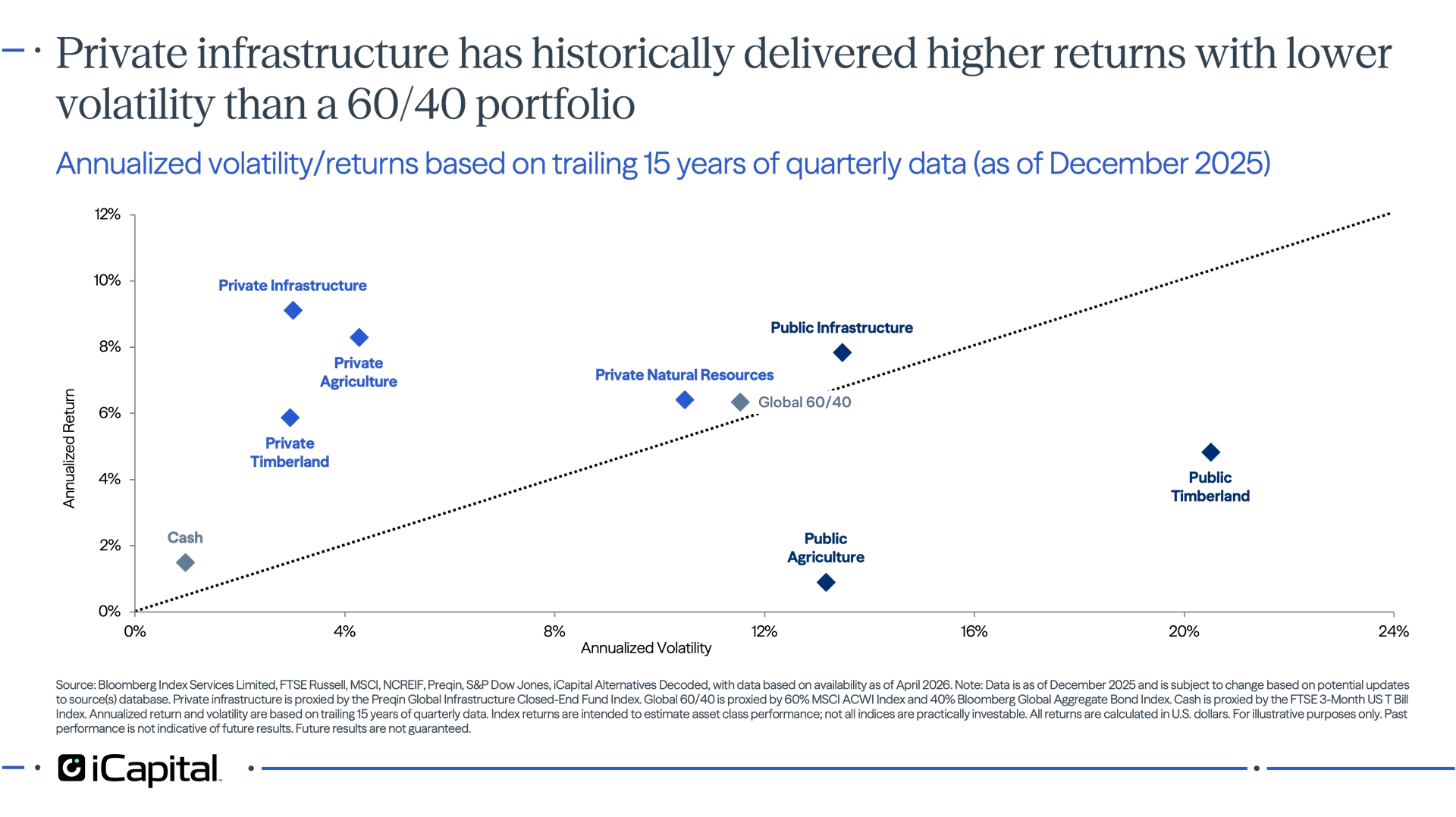
DECODED INSIGHT: Risk and return can look different in private markets. Private infrastructure has historically shown competitive returns with lower reported volatility than traditional public markets in the period shown. But private assets are valued less frequently than publicly traded investments, which can make their reported volatility appear lower.
What are the risks of infrastructure investing?
The main risks of infrastructure investing are development and execution risk, regulation and policy, interest rates and financing costs, and manager selection.
- Development and execution risk. New projects can face construction delays, cost overruns, permitting challenges, or changes in expected demand.
- Regulation and policy. Infrastructure often operates in regulated industries, making changes in regulation, policy, and tax treatments across jurisdictions important to outcomes.
- Interest rates and financing costs. Infrastructure projects often require significant upfront capital and have long payback periods, making financing costs an important consideration.
- Manager selection. Sector expertise, sourcing capabilities, operating experience, and the ability to execute complex projects can vary meaningfully across managers.
Myth vs. Fact: Common questions about infrastructure
| Question | Answer |
| Is infrastructure only about roads and bridges? | No. Infrastructure also includes utilities, energy systems, data centers, digital networks, and other essential assets. |
| Is infrastructure always low risk? | No. Risk varies significantly. An operating core asset and a new infrastructure development can have very different risk and return profiles. |
| Can infrastructure offer growth? | Yes. Value-add and opportunistic strategies may seek capital appreciation through development, expansion, or operational improvements. |
The bottom line: What should investors know about infrastructure?
Infrastructure provides the physical and digital systems that economies rely on every day. For investors, those assets can offer recurring income, potential inflation sensitivity, and return drivers that differ from traditional markets.
But infrastructure is not one uniform investment. Outcomes depend on the asset, development stage, revenue structure, financing, and manager. Understanding those differences is the first step in evaluating where infrastructure may fit in a portfolio.
INDEX DEFINITIONS
Preqin Global Infrastructure Closed-End Fund Index: A fund-level, capitalization-weighted, net-of-fees index denominated in USD covering approximately 750 closed-end infrastructure funds across Core, Core-plus, Debt, Opportunistic, and Value-Add strategies since Q3 2006.
MSCI ACWI Index: MSCI’s flagship global equity index designed to represent the performance of large- and mid-cap companies across developed and emerging markets around the world.
Bloomberg Global Aggregate Bond Index: A measure of global investment-grade debt across multiple local-currency markets, including government, corporate, and securitized fixed-rate bonds from developed and emerging-market issuers.
FTSE Three-Month US T Bill Index: An index intended to track the daily performance of three-month U.S. Treasury bills and used here as a proxy for cash returns.
IMPORTANT INFORMATION
The material herein has been provided to you for informational purposes only by Institutional Capital Network, Inc. (“iCapital Network”) or one of its affiliates (iCapital Network together with its affiliates, “iCapital”). This material is the property of iCapital and may not be shared without the written permission of iCapital. No part of this material may be reproduced in any form, or referred to in any other publication, without express written permission of iCapital.
This material is provided for informational purposes only and is not intended as, and may not be relied on in any manner as, legal, tax or investment advice, a recommendation, or as an offer or solicitation to buy or sell any security, financial product or instrument, or otherwise to participate in any particular trading strategy. This material does not intend to address the financial objectives, situation, or specific needs of any individual investor. You should consult your personal accounting, tax, and legal advisors to understand the implications of any investment specific to your personal financial situation.
ALTERNATIVE INVESTMENTS ARE CONSIDERED COMPLEX PRODUCTS AND MAY NOT BE SUITABLE FOR ALL INVESTORS. Prospective investors should be aware that an investment in an alternative investment is speculative and involves a high degree of risk. Alternative investments often engage in leveraging and other speculative investment practices that may increase the risk of investment loss; can be highly illiquid; may not be required to provide periodic pricing or valuation information to investors; may involve complex tax structures and delays in distributing important tax information; are not subject to the same regulatory requirements as mutual funds; and often charge high fees. There is no guarantee that an alternative investment will implement its investment strategy and/or achieve its objectives, generate profits, or avoid loss. An investment should only be considered by sophisticated investors who can afford to lose all or a substantial amount of their investment.
iCapital Markets LLC operates a platform that makes available financial products to financial professionals. In operating this platform, iCapital Markets LLC generally earns revenue based on the volume of transactions that take place in these products and would benefit from an increase in sales for these products.
The information contained herein is an opinion only, as of the date indicated, and should not be relied upon as the only important information available. Any prediction, projection, or forecast on the economy, stock market, bond market, or the economic trends of the markets is not necessarily indicative of the future or likely performance. The information contained herein is subject to change, incomplete, and may include information and/or data obtained from third-party sources that iCapital believes, but does not guarantee, to be accurate. iCapital considers this third-party data reliable, but does not represent that it is accurate, complete, and/or up to date, and it should not be relied on as such. iCapital makes no representation as to the accuracy or completeness of this material and accepts no liability for losses arising from the use of the material presented. No representation or warranty is made by iCapital as to the reasonableness or completeness of such forward-looking statements or to any other financial information contained herein.
Securities products and services are offered by iCapital Markets, an SEC-registered broker-dealer, member FINRA and SIPC, and an affiliate of iCapital, Inc. and Institutional Capital Network, Inc. These registrations and memberships in no way imply that the SEC, FINRA, or SIPC have endorsed any of the entities, products, or services discussed herein. Annuities and insurance services are provided by iCapital Annuities and Insurance Services LLC, an affiliate of iCapital, Inc. “iCapital” and “iCapital Network” are registered trademarks of Institutional Capital Network, Inc. Additional information is available upon request.
©2026 Institutional Capital Network, Inc. All Rights Reserved.
ACA#1039104 11/26