


Key Takeaways
- Markets may be entering a new Fed regime, where economic data and Fed speeches matter more than scheduled FOMC meetings as policymakers step back from forward guidance.
- The path of oil prices may be more important than the July meeting itself, with the outcome of the Iran conflict likely determining whether inflation continues to cool or reaccelerates.
- Investors should prepare for a wider range of outcomes, as cooling labor markets, elevated energy prices, and shifting Fed communication create greater uncertainty around the policy path.
On paper, this week’s Federal Open Market Committee (FOMC) meeting is a non-event. No expected rate move. No forward guidance. No new dot plots. Little to say on the recently launched task forces. Fed watchers looking for direction will likely leave disappointed.
But an uneventful meeting is not an unimportant one. This is a key input into how markets recalibrate their reaction function for the Kevin Warsh era now that the Fed is deliberately giving investors less guidance. Warsh has made it clear that he opposes forward guidance and the Fed’s outsized role in markets, both hallmarks of the post-Greenspan, post-Global Financial Crisis (GFC) period. The Fed he is building looks more like the pre-GFC version, where intra-meeting commentary and incoming data moved markets more than the meetings themselves [Exhibit 1].
For investors, the arithmetic is simple and uncomfortable: less transparency means more uncertainty. More uncertainty means more rate volatility spread across more than just meeting days. Since the introduction of the dot plot in January 2012, the median absolute daily change in the 2-year Treasury yield on FOMC days has run above 2x the median daily change across the rest of the year, a feature of an era in which investors were trained to hang on every word of long-form statements, extended pressers, and updated dot plots [Exhibit 2]. That reactivity is precisely what the Warsh-era Fed appears intent on walking back. If meeting-day communication is compressed and forward guidance is de-emphasized, the market’s information shock does not disappear; it redistributes, migrating from a handful of scheduled events into a steadier drip of intra-meeting speeches, data prints, and Fed-speak.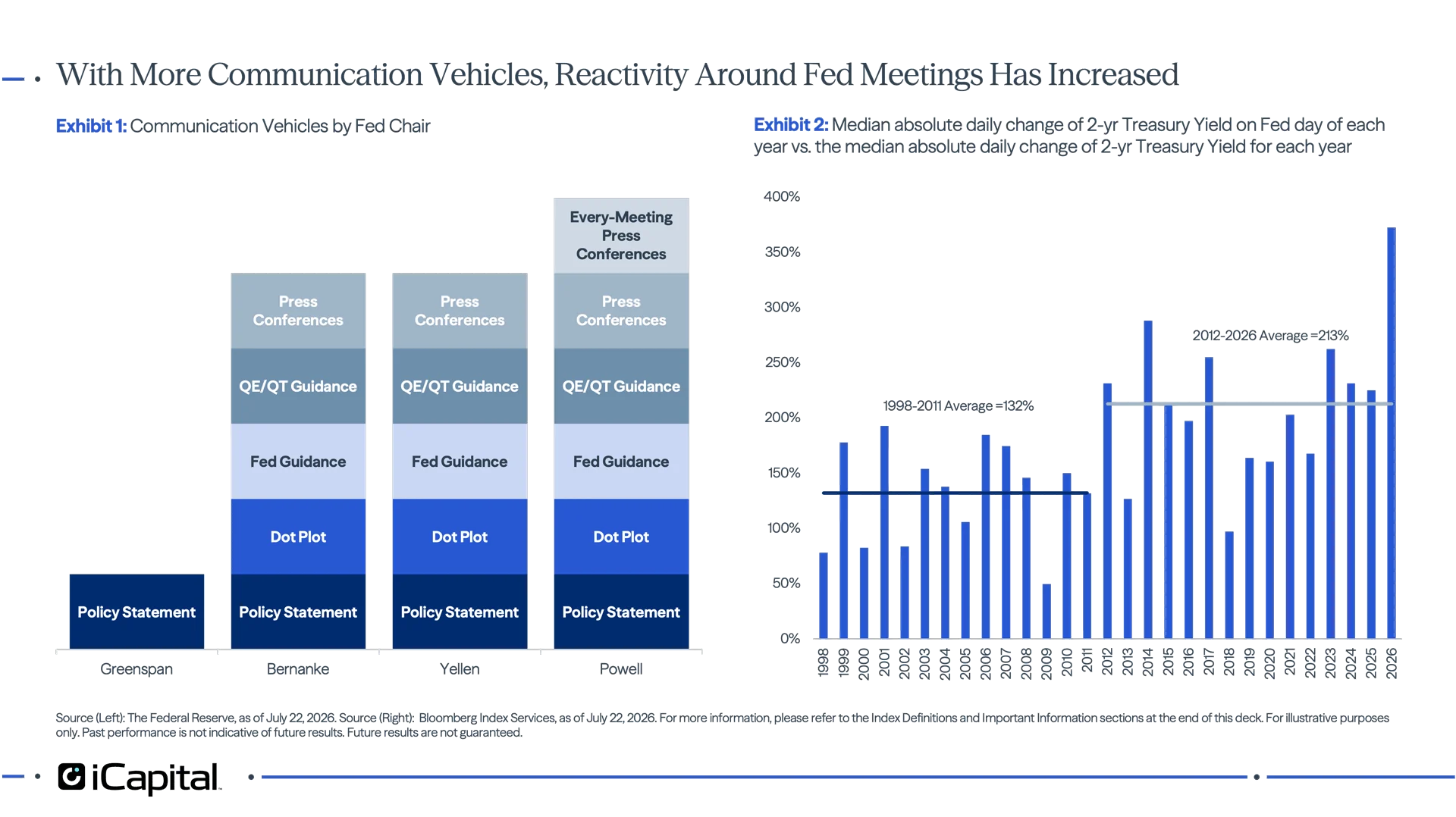 The likely consequence is higher baseline rate volatility across the calendar. Investors will be forced to reprice on incoming data rather than on guided expectations, not to mention the greater potential for policy surprises resulting from less transparency and guidance. July’s significance may lie not in what the Fed does, but in what it chooses not to say and how the market adapts.
Hawkish words, patient hands
Expect the July meeting to reinforce a familiar but increasingly consequential message: inflation is still too high. Warsh made clear in recent Congressional testimony that softer June CPI was not “mission accomplished,” and he will likely reiterate the Fed’s commitment to returning inflation to target.1
But it is important to look beyond tone. Warsh may sound hawkish because he is trying to build credibility on inflation, not because a September move is locked in. The soft June inflation reports probably bought the Fed another meeting and two more months of inflation and labor data before it has to decide. There will also be more time for U.S.-Iran negotiations to play out, potentially reopening the Strait of Hormuz and reversing the recent oil spike.
The takeaway for July: this meeting is less about the rate decision and more about reaction-function discovery.
Task forces: A 2027 story
In our view, the Fed’s new task forces are unlikely to draw attention in July. Any resulting policy is unlikely before early 2027 and will need FOMC buy-in, so expect more questions about their composition than concrete proposals on the table. Warsh has said he expects most, if not all, of the five groups to complete their work by the end of the year, with findings reported back to the FOMC for consideration, meaning the earliest practical policy implications land in the 2027 framework debate.
Still, they reinforce the Warsh thesis. The direction of travel is a Fed that leans less on forward guidance and more on scenario analysis, alternative data, and harder questions about inflation measurement, productivity, and the balance sheet.
The two task forces worth watching in the near term are Communications, whose findings could validate or blunt the reaction-function shift discussed above, and Inflation Frameworks, given how directly it bears on how the Fed processes recent supply-driven inflation shocks. But those reviews are a 2027 story. The more immediate one is playing out right now, in the push and pull between oil and labor.
Rock, meet Strait
Labor and oil are the rock and the hard Strait: one cooling in a way that argues for patience but not for cuts, the other squeezed by a conflict the Fed can’t influence. Together, they sort into four distinct paths for policy, and for now, the data points to one in particular.
Base case: Iran de-escalates and the Fed holds
June inflation offered a preview of what the world looks like once the Strait of Hormuz reopens and oil prices ease. Headline CPI fell 0.4% month-over-month, the largest decline since April 2020, cooling the annual rate to 3.5% from 4.2%, with core flat and PPI final demand down 0.3%.2 3 If peace talks prevail and Hormuz reopens, we would expect that disinflationary trend to resume. The labor side is cooperating too: the June payroll report softened but held near the pace of population growth, and unemployment claims just hit their lowest level since 1969.4 5 Inflation drifting toward target alongside stable employment is exactly the backdrop that keeps policy on hold.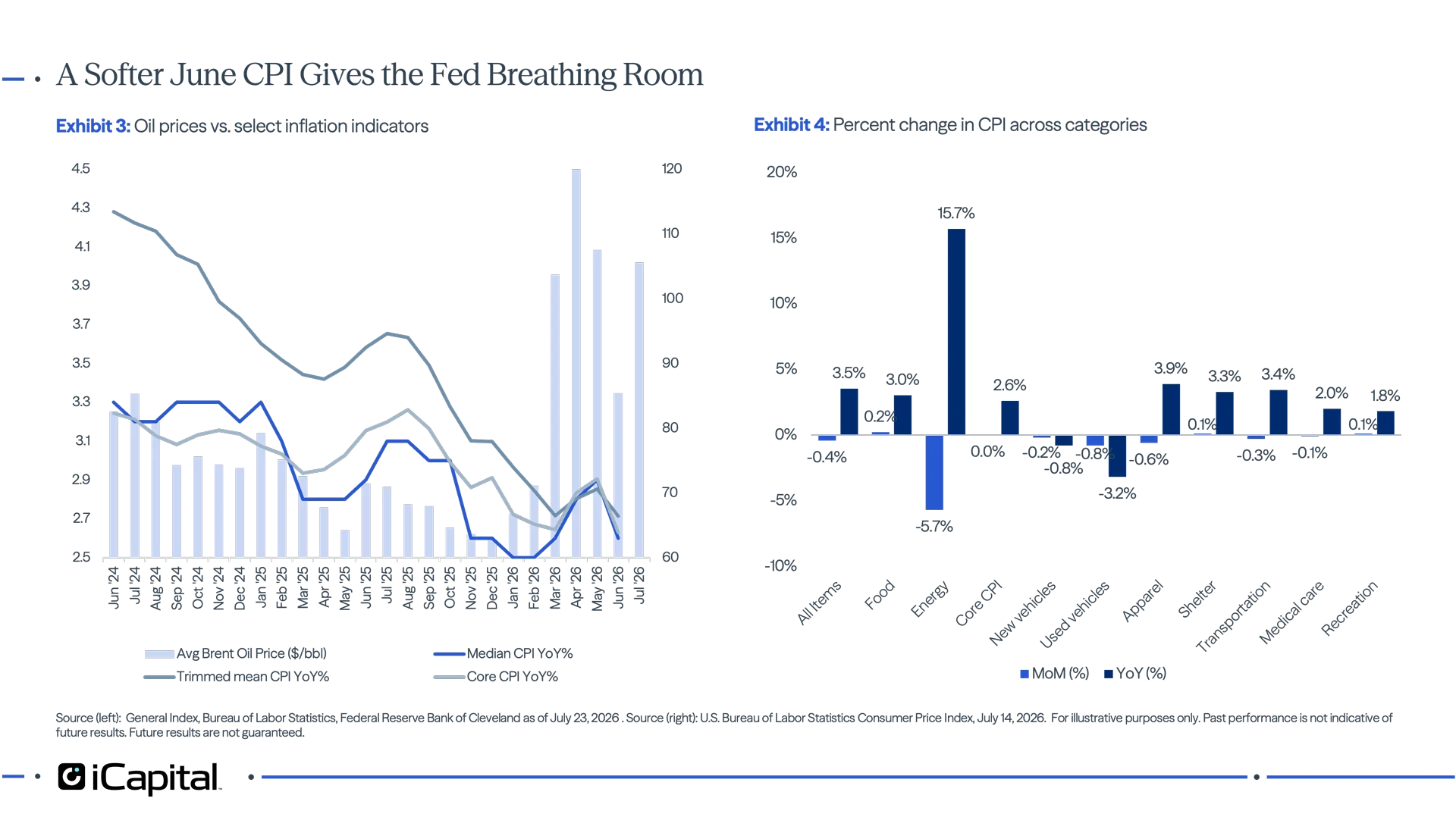
Hawkish case: the conflict drags on, forcing the Fed to hike
If oil prices hold above $80 a barrel through August, we think it would likely push the Fed to begin a hiking cycle in September, with further moves possible in October and December absent clear progress on inflation. New tariffs would compound the pressure. Warsh and other FOMC members have said a one-time price boost from tariffs would not, on its own, be treated as inflationary, but with the effective rate drifting back toward the ~10% level that prevailed before the earlier round of tariffs was struck down in court, that bump would land just as energy prices climb [Exhibits 5 & 6]. Two supply shocks at once are far harder for the Fed to look through than either alone.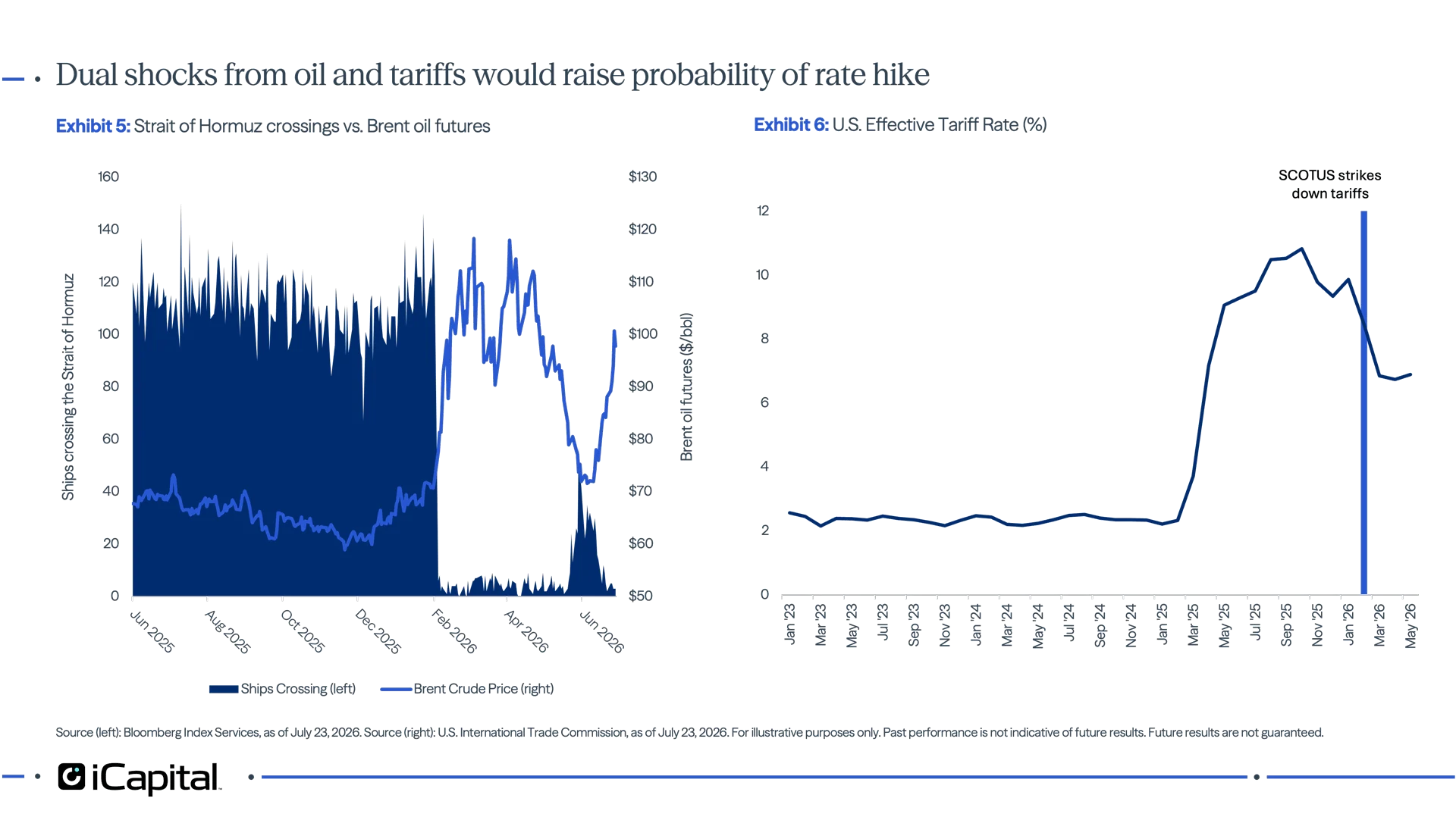
Dovish risk: the conflict resolves but growth slows too much
The Strait of Hormuz reopens and oil prices fall, but not before the earlier spike does structural damage to consumer behavior and business investment, the two channels most worth watching.
The consumer enters this episode with little cushion. Credit card balances sit near a record ~$1.25 trillion, the 90+ day delinquency rate hit a 15-year high of 13.1% in Q1, and the personal saving rate has slid to 3.0%, roughly half its level a year ago. 6 7 With the tax refunds that had propped up spending now in the rearview mirror, there is little left to absorb a fresh energy shock.
Business investment is the second pressure point. It has historically tracked interest rates closely, and rates at multi-year highs are biting just as the composition of capex turns fragile: many traditional categories are already stagnating or contracting, while the areas carrying the load, data centers and industrial equipment, may be showing signs of peaking.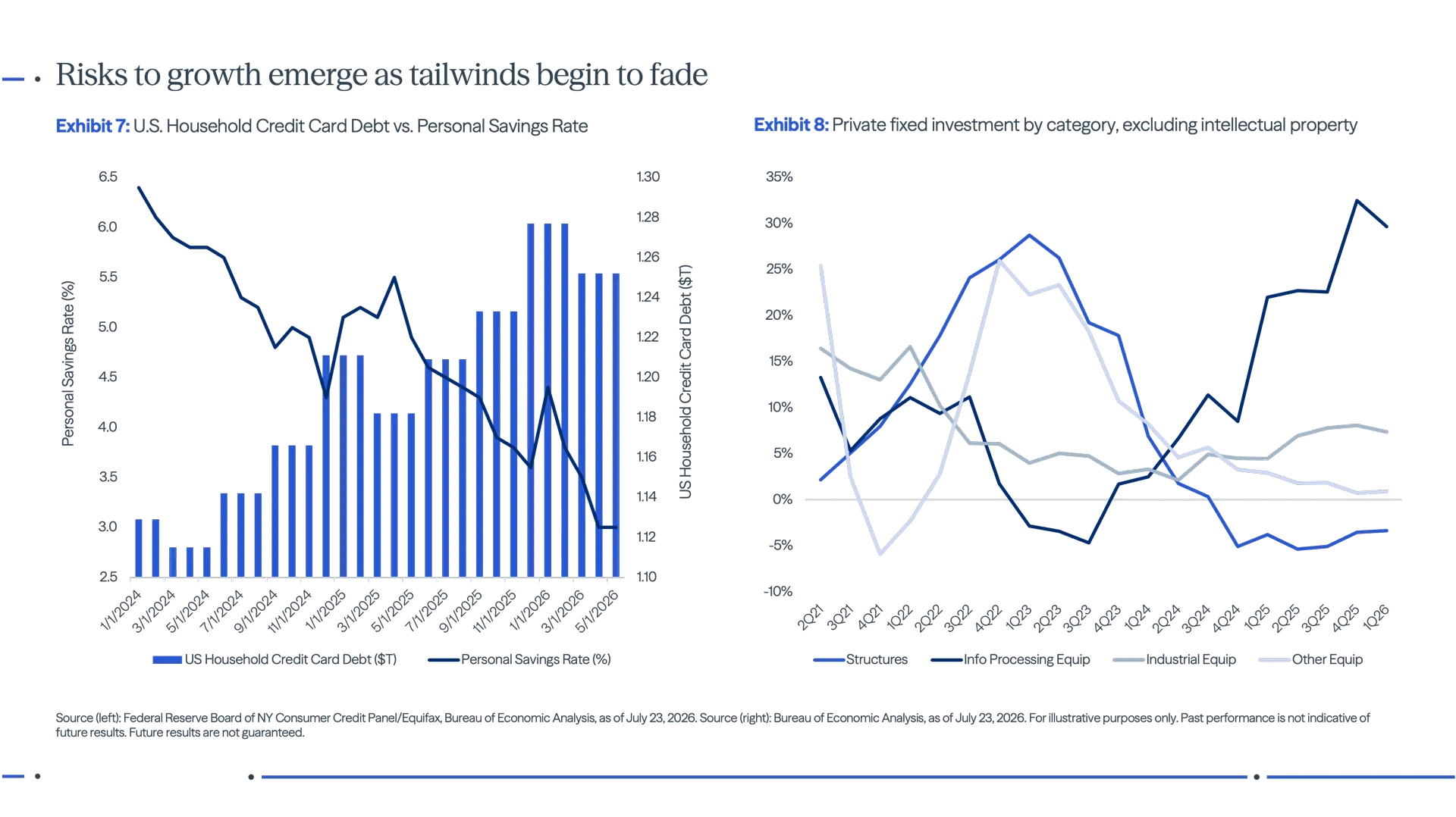
The labor market may be more fragile than that headline stability suggests. Over the year through June, total nonfarm payrolls rose about 506,000, but private education and health services alone added roughly 648,000, meaning one defensive sector accounted for more than all net job growth. [Exhibit 9]. Strip out healthcare and education and the rest of the labor market is already close to stalling. It wouldn’t take much of a demand shock to tip cooling into outright contraction, and lower inflation alongside falling jobs and slowing growth would likely push the Fed toward cuts.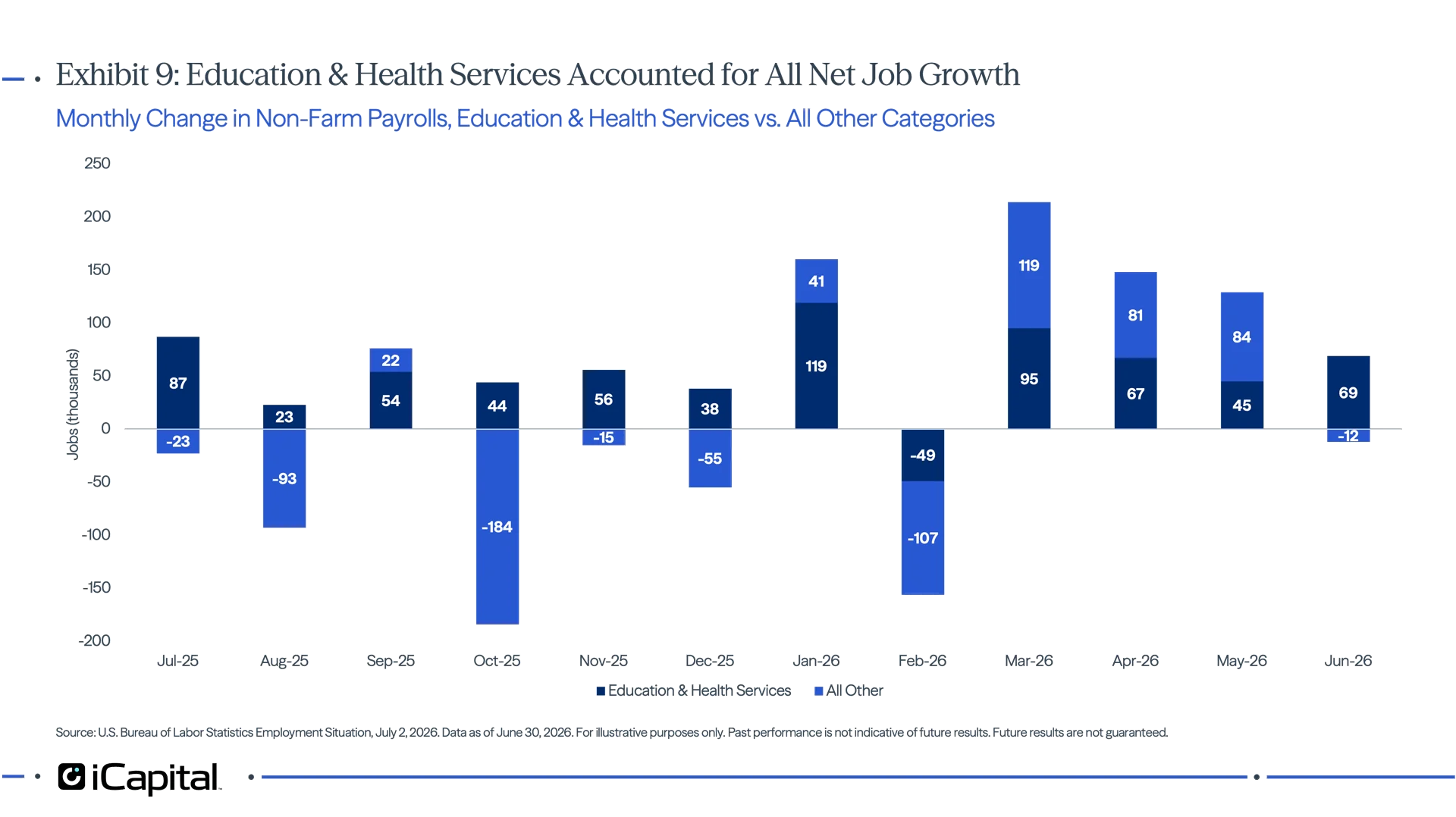
Worst case scenario: stagflation
The hardest path is the one where persistent inflation begins to trigger demand destruction, squeezing growth even as prices stay high. This is not our base case, but it would pose the Fed’s toughest communications challenge, with no single policy response that addresses both problems at once. Even cutting rates to support growth might only partially offset the upward pressure on borrowing costs from higher inflation. The last time the U.S. faced true stagflation, the Fed had to raise rates aggressively, forcing the economy into recession twice.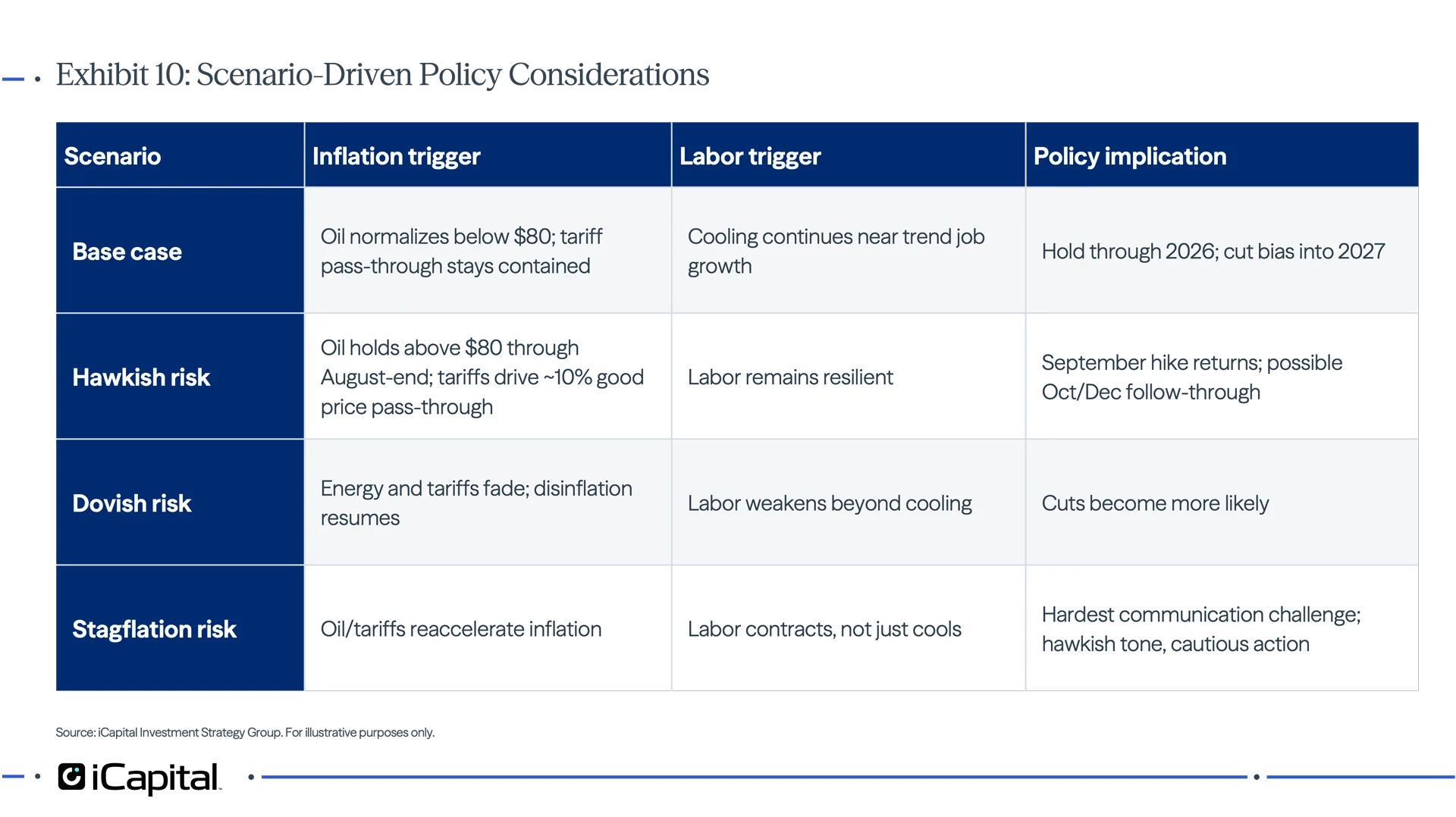
None of this will be resolved on July’s meeting day. That’s the point: under Warsh, the signal is shifting away from what the Fed says at eight scheduled meetings a year and toward what the incoming data—on oil, on labor, on tariffs—says every week in between. Investors would do well to read the tape rather than the transcript.
- U.S. Joint Congressional Semiannual Monetary Policy Report Hearing, July 14, 2026.
- U.S. Bureau of Labor Statistics Consumer Price Index, July 14, 2026. Data as of June 30, 2026.
- U.S. Bureau of Labor Statistics Producer Price Index, July 15, 2026. Data as of June 30, 2026.
- U.S. Bureau of Labor Statistics Employment Situation, July 2, 2026. Data as of June 30, 2026.
- U.S. Department of Labor Weekly Initial Jobless Claims, Seasonally Adjusted. Data as of July 18, 2026.
- Federal Reserve Bank of New York Q1 2026 Household Debt and Credit Report, May 12, 2026. Data as of March 31, 2026.
- U.S. Bureau of Economic Analysis Personal Income and Outlays, June 25, 2026. Data as of May 31, 2026.
INDEX DEFINITIONS
U.S. Consumer Price Index: The Consumer Price Index (CPI) is a measure of the average change over time in the prices paid by urban consumers for a market basket of consumer goods and services. Percent changes in the price index measure the inflation rate between any two time periods. Index captures roughly 88 percent of the total population, accounting for wage earners, clerical workers, technical workers, self-employed, short-term workers, unemployed, retirees, and those not in the labor force.
U.S. Producer Price Index: The Producer Price Index (PPI) program measures the average change over time in the selling prices received by domestic producers for their output. The prices included in the PPI are from the first commercial transaction for many products and some services.
IMPORTANT INFORMATION
The material herein has been provided to you for informational purposes only by Institutional Capital Network, Inc. (“iCapital Network”) or one of its affiliates (iCapital Network together with its affiliates, “iCapital”). This material is the property of iCapital and may not be shared without the written permission of iCapital. No part of this material may be reproduced in any form, or referred to in any other publication, without express written permission of iCapital.
This material is provided for informational purposes only and is not intended as, and may not be relied on in any manner as, legal, tax or investment advice, a recommendation, or as an offer or solicitation to buy or sell any security, financial product or instrument, or otherwise to participate in any particular trading strategy. This material does not intend to address the financial objectives, situation, or specific needs of any individual investor. You should consult your personal accounting, tax, and legal advisors to understand the implications of any investment specific to your personal financial situation.
iCapital Markets LLC operates a platform that makes available financial products to financial professionals. In operating this platform, iCapital Markets LLC generally earns revenue based on the volume of transactions that take place in these products and would benefit from an increase in sales for these products.
The information contained herein is an opinion only, as of the date indicated, and should not be relied upon as the only important information available. Any prediction, projection, or forecast on the economy, stock market, bond market, or the economic trends of the markets is not necessarily indicative of the future or likely performance. The information contained herein is subject to change, incomplete, and may include information and/or data obtained from third-party sources that iCapital believes, but does not guarantee, to be accurate. iCapital considers this third-party data reliable, but does not represent that it is accurate, complete and/or up to date, and it should not be relied on as such. iCapital makes no representation as to the accuracy or completeness of this material and accepts no liability for losses arising from the use of the material presented. No representation or warranty is made by iCapital as to the reasonableness or completeness of such forward-looking statements or to any other financial information contained herein.
Securities products and services are offered by iCapital Markets LLC, an SEC-registered broker-dealer, member FINRA and SIPC, and an affiliate of iCapital, Inc. and Institutional Capital Network, Inc. These registrations and memberships in no way imply that the SEC, FINRA, or SIPC have endorsed any of the entities, products, or services discussed herein. Annuities and insurance services are provided by iCapital Annuities and Insurance Services LLC, an affiliate of iCapital, Inc. “iCapital” and “iCapital Network” are registered trademarks of Institutional Capital Network, Inc. Additional information is available upon request.
©2026 Institutional Capital Network, Inc. All Rights Reserved.