From persistent inflation and elevated rates to the structural shift toward private credit and the evolution of capital markets, Waldron offers a grounded, cautiously constructive view of where we are, and what it will take for AI to deliver the growth the market is pricing in.
The Bridge EP 05, John Waldron/GS – Transcript
Sonali Basak (00:00:16 -> 00:00:45)
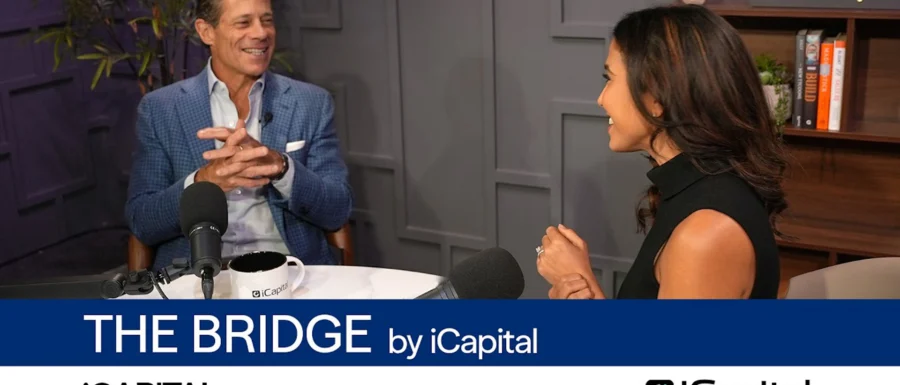
Welcome to the Bridge by iCapital. I am Sonali Basak. I am iCapital’s Chief Investment Strategist. And this is where we bridge you to the top investors in the world, the biggest voices in finance. And today we are joined by John Waldron. He is the Chief Operating Officer and president of Goldman Sachs. On a day where many RIAs are going to be joining Goldman for the RIA Professional Investor Forum. John, thank you for having us here. What are you expecting from the community of wealth managers here?
John Waldron (00:00:45 -> 00:01:38)
It’s great to have you in our building, Sonali. Appreciate it. Uh, we’re very excited about our RIA Professional Investor forum where we’ll have over a hundred executives in attendance for our third annual event. You know, I think that one of the value-add propositions for Goldman Sachs is we’re viewed to be, and I think it’s, it’s well earned over long periods of time. Astute risk managers, we certainly don’t always get it right, but I think the focus will be, how are you guys at Goldman Sachs thinking about this environment? It’s very dynamic. It’s very, very challenging. We’re obviously in the middle of a war, uh, oil prices very high. Um, you know, what is, what is your view on risk management? That’s going to be fundamentally the number one question. I’d say the second question is how are you thinking about AI holistically, obviously the capital investment, the returns on capital invested, but also deployment. We’re a very big enterprise deployer of ai and so they’re going to be asking us, I’m, I’m sure, questions about how we’re seeing the deployment in coding and in processes work, you know, workforce management and that kind, that type of thing.
Sonali Basak (00:01:38 -> 00:01:55)
We’re going to go into both of those things when we think about risk in particular. That was my first question also, when you think about where we are in the market, you’ve recently talked about the strong economy, but what breaks that at the end of the day? Is there anything that’s on your mind that investors should be much more cautious about in the future?
John Waldron (00:01:55 -> 00:02:54)
I do think the economy in the United States continues to be very strong. The consumer is showing extraordinary resilience, uh, much more so than I think most of us would’ve predicted, shows you the underlying strength. Uh, I think the wealth creation that’s occurred in this country is having a positive impact on everybody’s personal balance sheets, or not everybody, but a but, but a large proportion of the economy. Um, I think the two biggest risk factors are inflation, uh, and interest rates. And they’re obviously correlated. So, if we run with higher inflation and rates, particularly backend rates, therefore run higher, you end up with cost of capital in the economy that is higher and that can have a negative implication for growth over time. So that’s why I think you’re seeing and hearing everybody being acutely focused on the straight opening up with the oil markets.
Sonali:
Yeah.
John:
Getting the supply shock under better control. How long will that take? Where can oil prices ultimately migrate to? Will that keep inflation under relative control? And you can have growth with more modest inflation and therefore you get a, a much more buoyant economy.
Sonali Basak (00:02:54 -> 00:03:14)
Right. If we think about the last couple of years we’ve been living above the fed’s 2% target for years now, and we are at a juncture at which we’re looking at what was going to be a, uh, you know, trend back down towards that 2%. And now it looks like there’s a little bit of liftoff again, but how much of a liftoff, I think is what a lot of people are concerned about.
John Waldron (00:03:14 -> 00:04:17)
Yeah, it feels like inflation is running more like 3% than 2%. It felt like it was migrating more into the low to mid twos before the Iran war. Um, you know, our expectation is it is going to run hotter. Our own research is suggesting that, um, people have backed off their expectations of Fed rate cuts. So now you’ve got the, the prospect of a more neutral stance, you know, in the Federal Reserve policymaking apparatus, uh, alongside higher inflation. I would say. You didn’t ask about it, but labor is actually hanging in there. You know, I think much more strong, um, data on the labor side than would’ve been predicted. So right now, it’s unsettling and I understand why it’s unsettling, but frankly the data is not so bad. You know, I think inflation running a little hotter right now with oil elevated is not surprising. Under the covers of that, we think there are some elements that might be, um, you know, giving you more confidence that if we get through a big if, but if we get through the Strait and the oil market supply shock, you actually can see inflation start to migrate down closer to 2%. Whether we ultimately get to 2% as a much.
Sonali Basak (00:04:17 -> 00:04:21)
Right, I was going to say is 3% the new 2%? That’s a big question.
John Waldron (00:04:21 -> 00:04:38)
I don’t think. I don’t, I mean, I think if you get through the Strait and you get to the other side of the supply shock, again, those are big if, but let’s just assume for a second you do. I don’t think three percent’s the new 2%. I think it’s more like something in the twos. And the question is, is two and a quarter, two and a half, the new two, that to me would be the way I’d frame the question.
Sonali Basak (00:04:38 -> 00:04:55)
Something I worry about a lot is, you know, you think about not just the historic oil shock, we’ve seen the energy shock, but you think about the feed through effects and how long it takes to see a lot of those ripple effects really make its way through the economy. Do you think investors really have their minds wrapped around that second and third derivative effect?
John Waldron (00:04:55 -> 00:05:46)
Well, the equity markets certainly do. I mean, if you look at, I get lots of commentaries, I’m sure you do, from people saying, you know, how come the equity markets are so strong with oil prices where they are in the middle of a, a pretty challenging war. The equity markets, I think are telling you that will get resolved. You know, we don’t exactly know how we think over some reasonable period of time we’re going to get back to a more normalized oil market. And we’re really trading on the AI and other, you know, in business investment cases that have been sort of propelling the equity markets so, and the equity markets are telling you that this is a temporal shift in supply and shock to supply, but it will actually, uh, get to a better place. Credit markets, I think are also largely telling you the same thing with a little bit more of a signal that there’s some worry, you know, about longer term, more permanent structural inflation. Longer term, more permanent, higher rate structure, uh, and maybe a little bit of growth degradation.
Sonali Basak (00:05:46 -> 00:06:19)
Yeah. I would love for you to respond to a little bit of what we feel like is going to be the new reality, at least for 2026. We just said that we were revising up our forecast for the 10-year, right? We’re looking at four to 4.8 at the worst, right. Um, and we think that, you know, you can get through to 4.5 as we have, but the reason I ask you about this higher for longer narrative is A, do you think that we are in that zone, uh, throughout the rest of this year? And B, what does that mean? Because it can’t be the case that you don’t see some borrowers start to crack under that kind of pressure.
John Waldron (00:06:19 -> 00:07:18)
Well, it depends on how much growth, right? So, you, we can, we can quote interest rate numbers for the 10-year, but if you quote them divorced from the growth rate of the economy, then then, you know, that’s really, that’s nearly not the right way to think about it, I don’t think. So, if we have a four point a half or 4.3 quarter percent ten-year, but it comes with something that’s closer to 5% nominal GDP growth, then, you know, with let’s say two point a half or 3% inflation, then you’re actually in an environment that’s workable. You could want lower inflation and I’m sure government policy makers will want lower inflation, but that, that dynamic is workable if it comes with one and a half to 2% growth, very different picture. So, I think it really depends on what we’re going to see on the growth side. And I think fundamentally, a lot of this does come back to the business investment case around AI because that’s really the propellant of GDP growth right now in the economy. And so, if you were going to be worried about economic growth, I think you’d be worried about whether that AI investment spend A, continues and B, starts to generate returns on invested capital that can make this a much more permanent enduring growth.
Sonali Basak (00:07:18 -> 00:07:22)
Right, is the whole story kind of contingent on that kind of spend keeping up?
John Waldron (00:07:23 -> 00:07:41)
I don’t think the whole story is, but I think a lot of the story is driven by that. That to me, you know, you can see it in, in the equity market concentration, in the market caps of these companies. You can obviously see it in the deployment of capital in the economy. So, I certainly think it’s a big driver of economic growth and it’s a big driver to your good question about what’s the next couple years going to look like.
Sonali Basak (00:07:42 -> 00:08:00)
So, another question we keep on asking ourselves is, when do the AI CapEx vigilante show up? What stops this train? We have seen enormous amount of fundraisers in equity markets, in debt markets and in private markets. Um, at some point, don’t you look at yourself and say, our spread’s going to compress too much?
John Waldron (00:08:00 -> 00:10:01)
Well, I, look, I would frame it this way. I think that the supply of compute is going to grow at a very quick rate, very fast rate. And, and that’s a clear sense on the providers of compute that we are really short compute, and they see it every day in their business, in terms of what they think the demand function is likely to be, be it enterprise or consumer. And so, I, it’s to me, baked in the cake, you’re going to see an extraordinary amount of compute get built over the next, let’s just say, two to three years. Big question in my mind is how quickly will the demand start to catch up to that extraordinary investment in supply? I don’t think any of us really know the answer to that question, but I would say as a deployer from a Goldman Sachs perspective, with my COO hat on, we’re deploying a lot. We’re starting to really get into use cases. We’re starting to get a lot of, uh, benefit from our coding, uh, development software development capabilities. We’re seeing real early signs of productivity enhancement and improvement. And I think that we’re just scratching the surface. And most companies that I talk to would say a similar thing, seeing a lot of signs of, of early success, but we’ve got a lot more to do. So that demand curve is going to grow. And the question is, will there be a disequilibrium when we get out two or three years? We don’t know, but I’d be more inclined to believe that there’s going to be a lot of acceleration in demand, because I think we’re just starting to figure out how to do this two long poles in the tent. One is data. Most companies do not have very clean structured data. And the more structured and the cleaner your data, the more you can actually get the benefit from the AI deployment. And two is cultural change, right? We have to run our companies differently. We have to take processes that were run this way, turn ’em into a more modern set of processes and get the people that are in charge of all those processes and all those people to actually want to make that journey, which is not an overnight journey. So, I think enterprise deployment will lag in some respects, the supply and so, there’ll be, I’m sure tantrums along the way of saying, oh, there’s a gap, there’s a bubble. I would be circumspect about calling for a bubble. I think we’re not going to know for, for some years to come until we start to see how the deployment actually unfolds.
Sonali Basak (00:10:01 -> 00:10:16)
This applies to public markets and, and private markets, right? As we have seen a lot of people get concerned about private credit, but then there’s a whole other camp of people that realize, well, wait a minute, if we’re worried about private credit, shouldn’t we be worried about private equity? What do you say to those people?
John Waldron (00:10:17 -> 00:10:59)
Well, I think it is factually true that the equity is the riskier part of any capital structure. And so, if you’re worried about software credit, you should be paying attention to software equity. You know, our view would be most of the credit we see and the software that we’re participating in that we underwrite is secured by a lot of collateral and feels quite good to us. So, we’re not overly hysterical about software credit, um, paradigm. You know, I think if there are problems in software, it will first start to show up in the riskiest part of the capital structure, which is equity. So that stands to reason. And I think to me, too much press has been spilled on private credit and not enough focus on the fact that there’s a whole bunch of equity underneath that that is the first loss position, right? And that’s where you probably want to pay the most attention earliest.
Sonali Basak (00:10:59 -> 00:11:17)
But even in credit, it just feels like a lot of people are throwing a lot with the bath water here.
John:
Mm-hmm .
Sonali:
It just feels to me like 2026 could actually be an amazing vintage just because you have people now demanding more discipline and asking for higher rates. Do you think that there’s actually some great opportunities in software right now? Equally?
John Waldron (00:11:19 -> 00:12:00)
I think it’s early for there to be great opportunities in software, because what I said earlier, the, the disruption is still very, very nascent. And so, you would be taking, I think, a fair bit of risk to be particularly aggressive and ambitious in calling that disruption. I do think more broadly in private credit, we’re seeing institutional money wanting to deploy into what they think is a, a tantrum in private credit where they see opportunities, pricing gets better, terms get better, you start to be able to deploy that capital more intelligently. So, we, we actually at Goldman Sachs are taking in a fair bit of inflow, mostly from our institutional client base who sees this as an opportunity. And I think that’s not a software comment that’s a much more holistic comment across the economy.
Sonali Basak (00:12:00 -> 00:12:32)
Yeah. Bring, bring me under that thinking a little more here, because certainly there has been amazing institutional interest in private credit, even as we’ve seen very elevated redemption pressure. I would add that you guys did not see that in your main BDC relative to the other parts of the industry, but is there something countercyclical that people should realize about the way private credit works actually when things get tough and, and you know, say bank lending seizes up a little bit, that it’s kind of a better time to buy. Do you think that that’s a behavior that exists A, and B, that, uh, individuals need to be more privy to?
John Waldron (00:12:32 -> 00:13:56)
Well, we think private credit is a great asset class. Uh, before it was called private credit, we, we were doing it, you know, we we’re 30 plus years in this business of lending money to, to corporate entities, uh, in various ways, shapes and forms. Um, and I think our experience would lend us to believe that, that when you have a little bit of dislocation, terms get better, and when terms get better, you can deploy with higher risk-adjusted outcomes. And so, we like that. And I think that’s what you’re seeing right now is what, what happened for a period of time as there was so much growth in AUM in private credit that deployment was becoming the main thing as opposed to making, you know, the best underwriting judgements at all times. And when deployment becomes the main thing, you get competitive behavior, you get terms weakening, pricing weakening, and you start to get into frothier parts of the, of the environment. We’re now seeing that come off a little bit. I think it’s very healthy. I don’t love all the narrative publicly about how it’s all being framed, but put that aside, what’s going on is healthy. I think it was getting too frothy. And now we’re seeing AUM growths kind of come down a little bit. Interestingly, you’re seeing banks get more active. Some of that is as a re, as a result of the deregulation of the banking system. So, we’re actually would see more deployment coming from banks. That is a little bit of an offset to terms getting better because there’s more deployment coming in there. But I think the market’s getting a bit more rational and more balanced and, you know, we’re, we’re actually relatively on the balls of our feet right now looking to deploy into this environment.
Sonali Basak (00:13:56 -> 00:14:18)
Yeah, it’s interesting because a lot of people don’t remember, right? Goldman is so large, you’re, you’re leader in M&A and capital markets and trading, but you have a, a private markets business that is more than $600 billion in assets under management. It’s massive. And so, when you think about the next leg of private credit, what is it, what excites you about private credit and what does it look like tomorrow relative today?
John Waldron (00:14:18 -> 00:15:43)
Well, the, the growthiest, the growthiest opportunity is private investment grade, right? So, you think about it, there is probably $2 trillion, there’s probably a trillion dollars of invested AUM from alternative asset managers, private asset managers, into what we would call private investment grade. There’s another trillion dollars of four two, um, uh, money that’s invested by via insurance companies that’s pri, not publicly traded but privately owned and put away in insurance companies. So, call that $2 trillion. There’s probably another 20, 30, $40 trillion depending on how you count of investment grade deployed out there. Uh, much of it in liquid markets
Sonali:
mm-hmm .
John:
So, there’s a huge opportunity if you think you can deliver better absolute returns to start to eat into that 20, 30, $40 trillion. So, I think you’re going to see more migration of that fixed income that’s invested in investment grade rated, uh, assets, whether they’re public companies or collateralized pools migrating their way into private investment grade. So that that is going, and that’s investment grade rated underlying credit. So, I think that’s going to be the growthiest part of, uh, of private asset creation, private credit creation. Most of the focus has been on direct lending, which tends to be below investment grade rated middle market company, you know, kind of credit formation. But the reality is most of the growth, and I think most of the upside over time is going to be more in that investment grade rated spectrum.
Sonali Basak (00:15:43 -> 00:16:00)
It’s interesting because when you think about the spectrum of public to private, Goldman has made so many changes in credit businesses over the last couple of years, and, you know, how do you see that spectrum really playing out? Do the two things kind of look more like each other in some ways? Um, barring the structure of how you invest?
John Waldron (00:16:00 -> 00:17:27)
Well, we’re big believers in the public markets. Uh, we have been for a long time, and I believe we will continue to be for a long time. The public markets are extraordinarily important. The capital markets in this country, in the United States, one of the, one of the jewel assets of our country. And so we are, we are constantly promoting and explaining and, um, investing behind the public capital markets in America. I think it’s just something to be, to be, um, enamored with and invested behind. Uh, having said that, for lots of good reasons, private markets continue to grow, and they do offer a real opportunity. Uh, they offer more capital formation. They offer traditionally more long-dated longer duration, uh, investment capital where people don’t feel like they need to have quarterly decision making or daily decision making. They can actually put the money away for longer periods of time. So that tends to give you duration, which is valuable. So, there’s a role for both, and I think both will continue to grow. I think the growth in private assets in some aspects will probably moderate a bit as there’s been an enormous boom. And you’ll see a, I think a maturation process and a consolidation of that growth. But there’ll be aspects, as I said, in private investment grade where I think you’ll see continued escalation and growth. Private equity has moderated as a growth as a growth category. Real estate has gone through its own cycle and moderated. So, you know, the growth rates will be, will be, um, up and down over time. But I think the private asset class category will continue to be an increasingly important part of capital formation in our economy.
Sonali Basak (00:17:27 -> 00:17:39)
What do you think was to be learned from the first quarter of 2026? We think about how the individual investor has accessed these funds. Um, what is the great learning coming out of this moment
John Waldron (00:17:39 -> 00:17:40)
In private assets?
Sonali Basak (00:17:40 -> 00:17:59)
Yeah, you know, I think, you know, you have definitely spoken recently about the semi-liquid dynamic, and you know, we ourselves, don’t use the word we don’t like it, all people hear is liquid and not, um, the fact that these are largely illiquid. Do you think, you know, at least to me the great learning is 5% is 5%, right? Yeah. That there is a cap.
John Waldron (00:17:59 -> 00:19:36)
Well, I, I think that what’s important, as I said, we’re big believers in the asset classes of private credit investing. And I think that that wealthy individuals at all levels of the wealth spectrum deserve the ability and the opportunity to invest into some of the very same opportunities that our institutional clients get to invest in. However, there’s suitability factors, right? So, if you’re running a trillion dollars as an asset, as a, as an allocator, as an institution, you’re different than someone who has a million dollars of investible net assets or $200,000 of investible net assets. And you’ve got to think about that suitability factor. And I think that for, for us, the manufacturers of this, of this product and solutions capability, one of our obligations is to explain the suitability, explain the liquidity, explain the return, the expected returns, explain the duration. And I’m not suggesting that that hasn’t been explained, but I think that we have an extraordinary responsibility to make sure that we’re doing the best job we can as a, as an industry to disclose with a lot of transparency and explain what people should expect. And I think one takeaway to me is when people are using words like semi-liquid in that disclosure and that explaining process, they’re not exactly clarifying in the mind of the end customer what the real liquidity function is. And so, you’re right, 5% is 5%. That’s a structural element, uh, and has real benefits to, you know, having the ability to continue to be patient and invest over time. But for the end customer, you got to understand that this is not really a, this is not a feature of your portfolio that you’re going to have access to for liquidity purposes. You should have other features of your portfolio that really deliver that.
Sonali Basak (00:19:36 -> 00:19:46)
Right? It feels to me that model portfolios and advisors working kind of extra overtime here to just kind of choose how much liquidity is possible for that end investor is going to be kind of the key here.
John Waldron (00:19:46 -> 00:20:12)
Yeah, it’s a combination of the manufacturers, as I said, and the advisors and the RIAs and the other wealth, uh, platforms, doing a good job explaining to the end customer how this fits into your portfolio, how it you should think about it from a liquidity standpoint and how you should think about it from an expected return and duration standpoint. And I think that, you know, we all can do better in continuing that education process as we’re in the earlier days of people allocating more into private markets.
Sonali Basak (00:20:12 -> 00:20:50)
So that brings me to private equity, um, or venture capital. It feels to me like these days the two are starting to blur with how late stages, how late of stages you’re seeing for some of these rounds. Um, I keep on saying, you know, there’s funds where you can see, you know, Jersey Mikes and Anthropic next to each other these days right? So, if you’re sitting there looking at, uh, the late-stage venture world, many of some of these firms are about to go public. What does that mean for this market? Do you think it is going to attract a lot more interest or do you think that there’s actually kind of some risk here given how large these IPOs are and that, you know, we’ve really never seen these types of companies, uh, head to public markets before?
John Waldron (00:20:51 -> 00:22:00)
Well, we’ve seen great companies go public over time. Some of the great companies that you and I watch every day, Google, Amazon, Nike, Apple, you know, extraordinary companies that have gone public, uh, at the time they went public, there was always a question about -how great are they, how much support will they have? Can we raise all that money? Is the valuation too rich? So on and so forth. So, this is, in my mind, this is not a new debate, um, vis-a-vis the IPO market, but the size and scale of these companies at this juncture, uh, is unprecedented, right? So, and why is that? Well, partially it’s because of the explosion in, in valuations and the, the unprecedented amounts of capital being invested into the sector of, let’s say broadly AI and technology and software. Partially it’s because companies have been, have stayed private longer, right? We have not actually seen for the last 10 or 15 years the level of IPO activity that we would’ve seen in the prior 10 or 15 years with, you know, a couple of exceptions in certain years. But broadly speaking, we have actually seen a decline in the number of public companies a decline in the IPO volumes and more private to your earlier question, more money going into private investing.
Sonali Basak (00:22:00 -> 00:22:16)
Something interesting to me is not just the scale of these IPOs, but also the fact that a lot of it might go to retail, right? Uh, you know, are the capital markets changing a little bit here where, you know, the texture of an IPO is going to let more people in.
John Waldron (00:22:16 -> 00:22:57)
We’ll see. First of all, retail, you know, can, can encompass a broad swath of very wealthy family offices and, you know, moms and pops that are, that are investing, you know, at lower levels of, of, um, of allocation. I do think you’ll probably see more retail participation in these deals than you would’ve seen in prior periods. They’re pretty well-known companies at this point. So, there’s a branding associated with them. So yeah, it wouldn’t surprise me that you see the allocation to retail being higher, but I I still think that the vast majority of the price discovery in these transactions will come from the large institutional pools of capital. And so, at the end of the day, that’s really the thing that that’s going to have to go well in the context of making these deals work.
Sonali Basak (00:22:57 -> 00:23:12)
When you have these large companies that are raising money from dozens of investors in the pre-IPO rounds, how does that change the calculus of how you think about an IPO? We’ve stopped calling them private companies. We started calling them quasi-public from where we sit.
John Waldron (00:23:13 -> 00:23:45)
I think given the scale and size of the money that’s going to get raised in the IPOs, um, you’re still talking about real price discovery. Uh, obviously the prior rounds and the, and the mark to market on whatever the last trade was in a, in a private context is relevant to an extent when you’re talking about tens of billions of dollars of capital at a, at a moment where you’re trying to establish a price. It’s not that different from any other IPO. It’s just bigger. And so, I think it’s ultimately the price discovery will be driven a lot by the dynamic of the institutional demand supplemented by the retail demand.
Sonali Basak (00:23:45 -> 00:24:05)
You think about some of the, the darlings of the most recent technology era, there were huge free cash flow stories. Do you think that some of these new companies that will be the largest companies in American indices, given how much cash burned there is going on, do you think that investor psychology has a change to some degree?
John Waldron (00:24:06 -> 00:24:12)
Uh, you know, it’s funny, I would observe the following. I I, I’m going to, I’m going to remember Amazon because I remember sitting
Sonali Basak (00:24:12 -> 00:24:13)
baby Amazon,
John Waldron (00:24:13 -> 00:24:21)
Well, I would just remember the Amazon, the bookseller, right? Right. The, the, the e-commerce bookseller when Amazon came on the scene ultimately went public, pre
Sonali Basak (00:24:21 -> 00:24:23)
Whole Foods, pre-Prime, all that, right?
John Waldron (00:24:23 -> 00:25:28)
Pre-cloud.
Sonali:
Yes. Okay.
John:
So, Amazon was burning an enormous amount of money trying to build this e-commerce platform. And yet the stock, the IPO successful, the stock traded extraordinarily well. And a lot of people, myself included, were kind of staring at this thinking, how is this working? They’re burning money. They’re not making money, they’re burning money, and the valuation keeps going up and the capital markets are supporting this company. Okay, well, lo and behold, they built multiple businesses, multiple profit engines, they scaled beyond certainly my expectation, maybe not their expectation, and they’ve been extraordinarily successful. So, I think it tells you a couple things. The capital markets to the US capital markets, an incredible willingness and appetite for risk capital behind very good ideas. And then as the execution starts to become more clear, the risk capital even accelerates. If the execution isn’t clear, the risk capital can run in the other direction. I’m not aware of any other capital market in the world that allows for that over that duration of time. As long as the companies keep executing. If the companies don’t execute, then they will be punished in the capital markets. Like all of us get punished in the capital markets if we don’t execute.
Sonali Basak (00:25:28 -> 00:25:34)
Do you worry sometimes that we’re over allocating towards artificial intelligence and not everything else? Well,
John Waldron (00:25:34 -> 00:26:43)
I think at this point, sure, I worry about it at this point in the cycle, we’re allocating a lot to the build of the infrastructure of compute. Ultimately, the build of that infrastructure starts to migrate its way into the rest of the economy as companies and, and individuals start to, to use the compute and deploy the compute. So not unlike when you go back to think about the building of the internet or railroads or, you know, whatever other analogy you want to bring. Those that are assembling the infrastructure and building infrastructure are attracting the capital and the concentration. And over time, as more and more people find ways to deploy and use that, that might migrate into those folks that become more productive and create more value over time in the chain. So, the, the, the value chain will migrate. Right now, the value chain looks like chips and maybe memory, uh, and it’ll start to migrate, you know, through the chain. So, I think we’re, we’re at that stage of the cycle where it’s more concentrated. I think you have to worry about it because any time in history you’ve looked at something where it’s that concentrated, uh, it has, you know, it has often disseminated, uh, you know, into other parts of the economy and those values have come down. And so, I think we have to be worried about that. Um, but it’s not entirely surprising to me, me, given where we are in this particular part of the cycle.
Sonali Basak (00:26:43 -> 00:27:13)
So, you know, we, we started talking about the geopolitical a little bit here, and I think it relates a lot to what we’re seeing in artificial intelligence, the idea of, um, the president’s very tense relationship with China at the moment. We are also thinking through the supply chain questions that would come out of, uh, a lot of the geopolitical tension we’re seeing. Doesn’t something have to give here? I mean, you think about, um, you know, the potential increase in prices as we’ve been talking about. What does that mean? Doesn’t that just make the AI build out much more expensive?
John Waldron (00:27:13 -> 00:27:27)
Well, I think that you’re hitting on an important point. We’ve been talking about oil in this conversation earlier and supply shock and oil as, as a, you know, as a driver of inflation. And it is another driver of inflation has been supply chain rebalancing.
Sonali Basak (00:27:27 -> 00:27:29)
I think more about helium prices more than I ever have.
John Waldron (00:27:29 -> 00:29:03)
Well, I mean, I think that there are supply chain choke points to your point in many, in many parts of the economy. Some of that, some of that is related to the AI build, and some of that is just related to general supply chain rebalancing and the fact that the world was kind of geared towards China as the manufacturing floor for the world, and people decided to adjust their behavior, you know, according to some of the geopolitics. So yeah, I think that’s a real, it’s a real question mark and a, and a real concern, and I think it contributes to structural inflation in the economy that needs to be thought about and, and navigated. I think it’s probably a safer, better world where people are building more resiliency in the supply chain. We wrote an op-ed about this in terms of strategic interdependence between the, the two countries, US and China. And one of the things that we believe in is that the US economy, if we just focus on the US, became too dependent on China as a manufacturing source, and is now doing, I think, a much better job finding multiple avenues of de of dependency and not being as dependent, but there’s still strategic inter, you know, dependence between the two countries. Um, by the way, I would say you’re right, that relationship can be described as more tense. I actually would give the Trump administration credit. I think they’ve done a pretty good job putting a little bit more of a floor under the relationship. Um, you know, one of the things we’ve said for a lot of years is the lack of engagement is very, very risky. You’ve got two superpowers, two large as economies in the world, two extraordinary, uh, two company countries that have extraordinary capabilities. And if they’re not talking and there’s not, there’s not real dialogue, then, you know, if things go awry, they can really go awry. So, I, I actually think they’ve done a, a, a pretty, both sides deserve credit for doing a good job getting it a little bit back, you know, on the rails.
Sonali Basak (00:29:04 -> 00:29:40)
It’s interesting because, um, you know, we were talking a lot about kind of US exceptional capital markets, but there’s another dynamic here that relates to us and the rest of the globe also and it’s our fiscal situation. On one hand, you know, you look at the math, and we’re not the worst house in town, actually, right? When you look at the, um, even the G10 and, uh, the debt to GDP ratios, but if we’re talking about higher for longer, it just means that our debt gets more expensive. And so how do you think about at what point that starts to matter to the rest of the world? At what point, if at all, does US debt become a lot less attractive, even with higher yields?
John Waldron (00:29:41 -> 00:30:18)
Well, the US economy is still the envy of the world. We’re in the middle of this extraordinary AI period. Um, you know, I think the US is leading, doesn’t mean that other countries aren’t playing a real role, and I think there’s a real debate about how far behind, if at all China is, and they’re running a slightly different play. Um, economic growth to me is the single most important thing. Uh, if the US economy is not growing at or near its potential, uh, there’s obviously all kinds of, um, problems with that. But one major problem is the debt, right? So, if we’re underperforming no different than a company was underperforming and you’ve got too much debt, then you start to have, you know,
Sonali Basak (00:30:18 -> 00:30:19)
We can’t grow our way out.
John Waldron (00:30:19 -> 00:31:49)
You start to run into problems, particularly if you have structural inflation, higher interest rates, a little bit of stagflation like that scenario is pretty risky, I think the more debt that you, that you carry. And so economic growth is far and away, to me, the most important thing, which is why I’m encouraged by what I see, are policies that are at least trying to drive more economic growth in our economy. And I think that’s critically important. We benefit, obviously, from the reserve currency. So sound stewardship of our, of our financial picture is important. Uh, people feeling like they want to own dollars is important. Um, so, you know, I’m still very bullish on America. I still think we have far and away the best system in the world. Uh, I wish we could get our spending under control. You know, I think both parties deserve, um, uh, some blame for not being more disciplined than our spending. Everybody’s got different priorities, but I think fundamentally, I wish there was more fiscal discipline in the context of how we do, how we, you know, allocate our, our resources. Um, and so, you know, if I had my way, I would want to see more economic growth and more discipline and spending. We’re clearly going to have to spend more in, in the military in defense. You know, I think that’s a, that’s a clear, um, to me next three to five years. I don’t see any way around that. Um, and so there’ll be more pressure on the budget if you think about, you know, the entitlement programs, the defense spending, you know, everything just seems to be climbing. Uh, and there, you know, there isn’t a lot of political will to try to attack any of these programs, uh, and start to prioritize where we really need to be spending versus where we can be, you know, spending less.
Sonali Basak (00:31:49 -> 00:32:22)
Yeah, and I want to recognize that at the beginning of 2026, we still have been living off of what you can consider fairly meaningful monetary and fiscal stimulus, right? The Fed has still been buying T-bills. We had mortgage-backed security purchases by the, the agencies we had, of course, fiscal stimulus with the one big, beautiful bill. What does that look like when that starts to taper off? Is what I wonder, are there fragilities in what’s the safest debt market in the world, arguably, that, um, are underneath the surface, given how many times in the last several years the Fed has had to step in?
John Waldron (00:32:23 -> 00:33:22)
Yeah, well, I think there’s an active debate and should be, and you can hear, you know, the incoming Fed chair, Kevin Warsh articulate this about how actively involved in the economy the Federal Reserve has chosen to be. Um, obviously in moments of crisis that seems more than appropriate and necessary, but I’m not sure at every moment that the Fed has chosen to be that actively involved in the, in the economy, that, that it was as necessary. If you want to talk about, you know, cracks in the system, I think worries about the size of that balance sheet and the engagement and the potential distortion in markets of governments being too, too involved. Um, I likewise think ongoing fiscal stimulus, uh, kind of at every moment where we almost think we want to outlaw recessions because we just never want to go through the pain and suffering of recession. I’m not rooting for a recession. It would not be good for Goldman Sachs. It would not be good for a lot of us. But sometimes you need a business cycle to clean things out. And, you know, it feels to me like we have gotten into the habit of let’s just spend our way to make sure that never happens.
Sonali Basak (00:33:23 -> 00:33:25)
It encourages bad behavior in some
John Waldron (00:33:25 -> 00:33:59)
It can encourage excessive behavior and it, and you don’t really clean out the system. You know, one of the things I remember being taught in my economics classes was these business cycles are a way to start to restore, repair, clean out the excesses, and kind of grow from a, you know, healthier base. And not everybody agrees with that or believes in that. Um, and I think that the government, you know, broadly, whether it’s fiscal or monetary, has kind of done its part to try to not have that happen. Uh, and I understand why, cause politically that’s not in anybody’s interest to, to have, you know, negative impacts on growth or, or otherwise, but I I, I do worry that we are buying ourselves a bigger problem down the road.
Sonali Basak (00:33:59 -> 00:34:26)
Yeah, absolutely. Something that’s in my mind too. Um, before I let go, what I’m going to ask you about is your own AI initiatives. You had talked a little bit about that, uh, your, uh, lead technology person came from AWS once upon a time we did. Uh, you’ve invested a lot in artificial intelligence and, and other types of technology, frankly, um, and for many years before GenAI, right? So, what are some of the more exciting things that are happening inside of Goldman Sachs as it pertains to how you’re using AI?
John Waldron (00:34:26 -> 00:35:13)
Yeah, I’m glad you asked me that. So, I’d say three things. One, um, we are focused on AI literacy in our company because we think we really want to bring the, the understanding and knowledge and reduce the fear as much as humanly possible so we can kind of democratize the literacy around, around our company. Um, we have many programs, you know, to do that we’re, we’re seeing very good take up, whether it’s, you know, putting tools out for people to use, we’ve got something we call GSAI assistant, which is basically our internal platform where we put the best models. Um, and you can start prompting and asking questions and getting, you know, getting, uh, inquiry back from, from, you know, whichever model is the best model for that particular inquiry. And so that’s an important thing, so that I call that broad adoption literacy.
Sonali:
Mm-hmm .
John:
You know, one major thrust
Sonali Basak (00:35:13 -> 00:35:21)
Before you get to the next part though. I mean, explain that fear, right? What, what do clients and what, sorry, what do employees tell you when they don’t want to use it?
John Waldron (00:35:22 -> 00:36:01)
Well, I just think it’s human nature, you know, I think it’s the same, it’s the same if you went out into the consumer world or you talked to anybody on the street and said, what do you, I mean, my guess is if you, if you did a poll of AI, you know, out on the street, it would be probably more negative than positive. You know, I’m going to lose my job, I’m going to, you know, I’m not people resistant to change. So, I think it’s more just this fundamental resistance to change a new technology, a new way of doing things, and then the, you know, all the narrative around, well, this is just going to be a job destroyer, so do I really want to, you know, kind of get in the middle of this? It’s not like people are wander around our firm with their hair on fire, worried about it, but we want to, we want to demystify it and put up and see, have everybody see that this tooling is actually quite helpful. It’s going to make you better. It’s not going to replace you; it’s going to make you better.
Sonali Basak (00:36:01 -> 00:36:06)
Right, do they find at the end of the day that their job is a little different when they use it, right? I mean, is that the….
John Waldron (00:36:06 -> 00:37:11)
Most of the feedback we get in the early days of people using the, the, the GSAI app platform is, wow, this is great. I I’m starting to actually become more effective in what I’m doing and I’m getting answers quicker and I’m actually becoming more productive. So generally speaking, I think it’s a, it’s a really good thing. That’s the first thing. The second thing is, I would say software development. So, this is a little bit back to your software question. Think about what’s happened in the last 10, 15, 20 years. Mark Andreessen said software would eat the world, and he was generally right. Software, you know, became critical to everybody’s operations. Um, and so, you know, five, 10 years ago, I remember thinking we we’re never going to have enough software developers, not enough coders. That’s going to be critical to our success. Well, it turns out we can actually now code with generative AI tools, uh, much more effectively, quicker, and get a lot more productivity, more output. So, we have seen enormous productivity gains in our software development lifecycle. Uh, so we sort of SDLC as a, as a term in our firm of beginning stages of building software all the way through, deploying it, monitoring it, maintaining it, and so forth. And so that,
Sonali Basak (00:37:11 -> 00:37:13)
Are you forcing yourself into Goldman Sachs hackathons?
John Waldron (00:37:14 -> 00:39:19)
No, uh, I’m not personally involved in the hackathons, but there are many, many hackathons and, and the feedback on those hackathons is terrific. So, we’re seeing 20, 30, 40% productivity gains in coding. Okay. In some cases, much more than that in the individual, you know, scenario. Uh, and so I think the more we can develop that capability, the better we’ll be. Because what we can do is we can just do more projects. I mean, we have plenty of project technology projects in our firm, whether it’s deferred maintenance or new things we want to build. And so, we’ll be able to push more output, you know, with a relatively similar number of coders. I don’t think you should expect us to start firing coders. I think you should expect us to start wanting to use that incremental output to do more things, which is very valuable for a firm like ours. And so that would be the second thing. The third thing, third area would be a broad swath of use cases around process re-engineering in the firm. So, the way I try to describe it to people inside our firm and sometimes outside our firm is, if you look back at a manufacturing company that today is very automated, you know, General Motors, an assembly line, you know, you make a car with an assembly line, now you make it with, with robots. Um, you know, any manufacturing business has in the last 10, 20 years basically become a very automated platform. Goldman Sachs, I’m not going to comment on our peers, but I suspect they’re similar, is still a human assembly line in much of what we do. And so, we’re not going to become all robots or all agents, but you can start to insert, let’s say robots, which in our case are probably digital agents that can start to create straight through processing capabilities where it’s not a human assembly line, it’s more of an automated assembly line with humans engaged in it and involved in it. And there’s always going to be humans in the loop, at least, at least as far as we’re concerned. But that’s a pretty big transition, a pretty big shift. You need good data. As I said, you need cultural willingness to want to take a, a, a process that look like this over here and make it a modern process. And you want to go through that journey. We need good partners, Anthropic, OpenAI, Google, Gemini, et cetera, et cetera. So, we’re going to need to be working with really good partners. And then you need the patience and willingness to actually just go through that slog in that process.
Sonali Basak (00:39:20 -> 00:39:36)
Well, it’s interesting, uh, you know, before you were the president of Goldman, you’ve kind of long been a very, very prominent investment banker, right? And you can arguably look at Wall Street and say that part of the industry is kind of the hardest to automate in a lot of ways. It’s client service. I mean, what do you say now?
John Waldron (00:39:38 -> 00:40:57)
I say there are many processes that we do in the firm that clients would not see. They just see us executing a transaction and getting the money that we raise for them, or getting the transaction done that they asked to have done. They don’t see behind the walls how it’s happening. And I think that behind the walls part can be significantly more modern, more scalable, more resilient, and obviously much more automated. And so that is an enormous opportunity for a firm like ours to become much more efficient, as I said, much like a manufacturing companies have already have already achieved. On the flip side, I think you’re going to see people that have high intellectual content, whether they’re bankers, wealth advisors, traders, um, salespeople get better because they’re going to have tools at their, at their disposal that are going to make that, that great intellectual content even better. Right? And I think we’re going to start to see more value proposition that we can deliver to our clients. And ultimately, I don’t know what that means in terms of our headcount and how many people are doing which jobs. I’m sure there’ll be some new jobs I think it develop, but one thing I’m pretty convinced of is that our really capable, smart people are going to get more capable and smarter. And I think that that’s going to near to the benefit of our clients, and hopefully that means our client relationships become stickier. The value proposition becomes stronger, and Goldman Sachs becomes even more important to them.
Sonali Basak (00:40:57 -> 00:41:09)
Yeah, the wealth community, just to hinge on that for just a second, it just feels like there hasn’t actually been a lot of innovation when it comes to artificial intelligence. It feels like there’s still a lot of white space left. Would you agree with that?
John Waldron (00:41:10 -> 00:41:47)
I would agree. I mean, I think there’s been some innovation, but I think there’s a lot of whites. I would agree with both comments. I think there’s plenty of white space, and I think that we will, I mean, I’ll give you an example. Onboarding private wealth clients at Goldman Sachs, pretty onerous takes too long. Not a great experience for the client, not a great experience for us. Um, very human right. Lots of documents, lots of, lots of signing, uh, you know, hand
Sonali:
manual,
John:
very manual. Uh, and it’s, it takes a longer time than it should. So, clients get frustrated with that. We don’t get to work with them as clients. We don’t get to, to prove our value proposition. We don’t get to earn any revenue over that period of time.
Sonali Basak (00:41:47 -> 00:41:48)
It’s just onboarding.
John Waldron (00:41:48 -> 00:42:33)
It’s just a, it’s just a, it’s a process that doesn’t really suit anybody right now. Fast forward 12, 18, 24 months, that’s going to be a very digital process. A lot faster, a lot cleaner, hopefully no paper, obviously the, you know, we’ll, we’ll try to get it to be all digital. One touch your signing will be DocuSign or some version of that. And it’ll be days, not weeks and months. That should be a better experience for the client. It should be a better experience for us. We can start giving advice faster. We can start executing, getting people invested in markets faster. It should be a virtuous outcome. There are so many of those processes at firms like ours that are better that way in the current house construct. And if we can build a more modern house, then we end up with something that suits everybody’s needs in a much more, um, much more attractive fashion.
Sonali Basak (00:42:34 -> 00:42:52)
I think this is the most important question. With all of this change, it’s pretty exponential across the industry, let alone many industries. What is your advice to somebody who is entering the workforce today in terms of what they’re going to need to be successful moving forward? We’re kind of, before this, we’re talking about how we’re econ and English majors. Yeah. Is that going to cut it?
John Waldron (00:42:53 -> 00:43:58)
Well, I’m a big believer in liberal arts. I have been a, for a long time, I might have gone through a little interlude where I, you know, wish that I was an engineer. Uh, but I think the liberal arts, I think the liberal arts will flourish. I I spent a lot of time on college campuses, um, you know, talking to liberal arts majors, talking to finance majors, talking to engineering majors and the like, I, I, I think the, the best advice I could offer is engage with the tooling. Don’t be afraid of it. Don’t be ignorant of it. Engage with it. Learn it, understand it. Um, and the more literacy you have, the more you’re going to understand how to be, um, confident with it and use it, uh, to your advantage. Um, and the more attractive you’re going to be to organizations like ours, because we’re not replacing all of our people with digital agents, but we’re going to expect you to understand how to work with a digital agent and how to think about that workflow. If you’re in that part of the firm or if you’re in the front office, part of the firm talking to a client, we’re going to expect you to understand how to use that tooling to make your relationship stronger and to deliver a better value proposition. So, I think it’s engaging with it, learning it, immersing yourself with it, not being afraid of it. And um, and I think you’re going to do very well if you do that.
Sonali Basak (00:43:58 -> 00:44:11)
Can I have you leave me with two big predictions? One is on the IPO market, outside of the biggest IPOs. Do you think that this is going to be a robust year for anything that’s not one of the big highflyers?
John Waldron (00:44:11 -> 00:44:30)
Well, it already has been. I mean, I think, you know, equity capital markets, volumes are up like 50% year to date. That’s not all IPOs, that’s, that’s broadly. Um, but it’s going to be a very good year. You know, unless we have some exogenous, you know, negative event in the marketplace, it’s going to be a very good year. Beyond just the larger scale IPOs
Sonali Basak (00:44:30 -> 00:44:32)
Prediction on the M&A market.
John Waldron (00:44:33 -> 00:46:24)
We may have a record year this year. Um, it may spill into ‘27 just given, you know, how long it takes for some of these transactions to be put together. But the bias for scale in, um, in the enterprise world today is as strong as I’ve ever seen it. It’s kind of a winner take most world, right? So whatever industry you’re in, if you’re the largest player and the second largest player, you’re generally outperforming from an economic standpoint, from an earning standpoint.
Sonali:
mm-hmm .
John:
And you’re getting a higher valuation. And so, it’s very virtuous to be big and very successful. Probably always been the case to an extent, but it’s much more the case today. And I think that there’s a risk, if you’re not in that arena of one of the larger, more successful players is a risk of real disruption and, and real degradation to your value. So, I think we’re seeing a push in that direction. And obviously AI to me is only an accelerant, uh, to that. So, the corporate ambition right now to create these scale, uh, consolidating transactions is quite robust. At the same time, we actually have a lot of spins and splits and carve outs. And so, what is that telling you? It’s not just scale for scale’s sake. It’s not like I just want to run a conglomerate. It’s scale and capability in your industry, in the area where you have the predominance. And if you have businesses that are not in that category, then you’re getting out of them. You’re either selling them or you’re distributing them via spin or split. And so interestingly, we have both engines firing at the same time. Typically, you have one or the other, but not both. And then, you know, the last part of that would be private equity, where we actually don’t really have that engine firing the way it has been firing. So, it’s really a corporate led environment. So, if we do start to get more private equity participation, you’ll actually see those volumes, you know, get even, even further afield. And as a percentage of market cap, we’re still not back to where we have been historically. So, M&A has a long way to run, as long as we have reasonably good underlying economic fundamentals.
Sonali Basak (00:46:24 -> 00:46:38)
John, it’s been such a pleasure to pick your brain today. Thank you for having us just ahead of a big conference. I know you have hundreds of people coming in, uh, from across the RA community. That was John Waldron, he is the president and COO of Goldman Sachs. And you have been watching the Bridge by iCapital.
END