
Artificial intelligence has moved quickly from novelty to workforce necessity. But as enterprise leaders look beyond experimentation, a new phase is taking shape—one that shifts AI from answering questions to actually doing the work of a human employee.
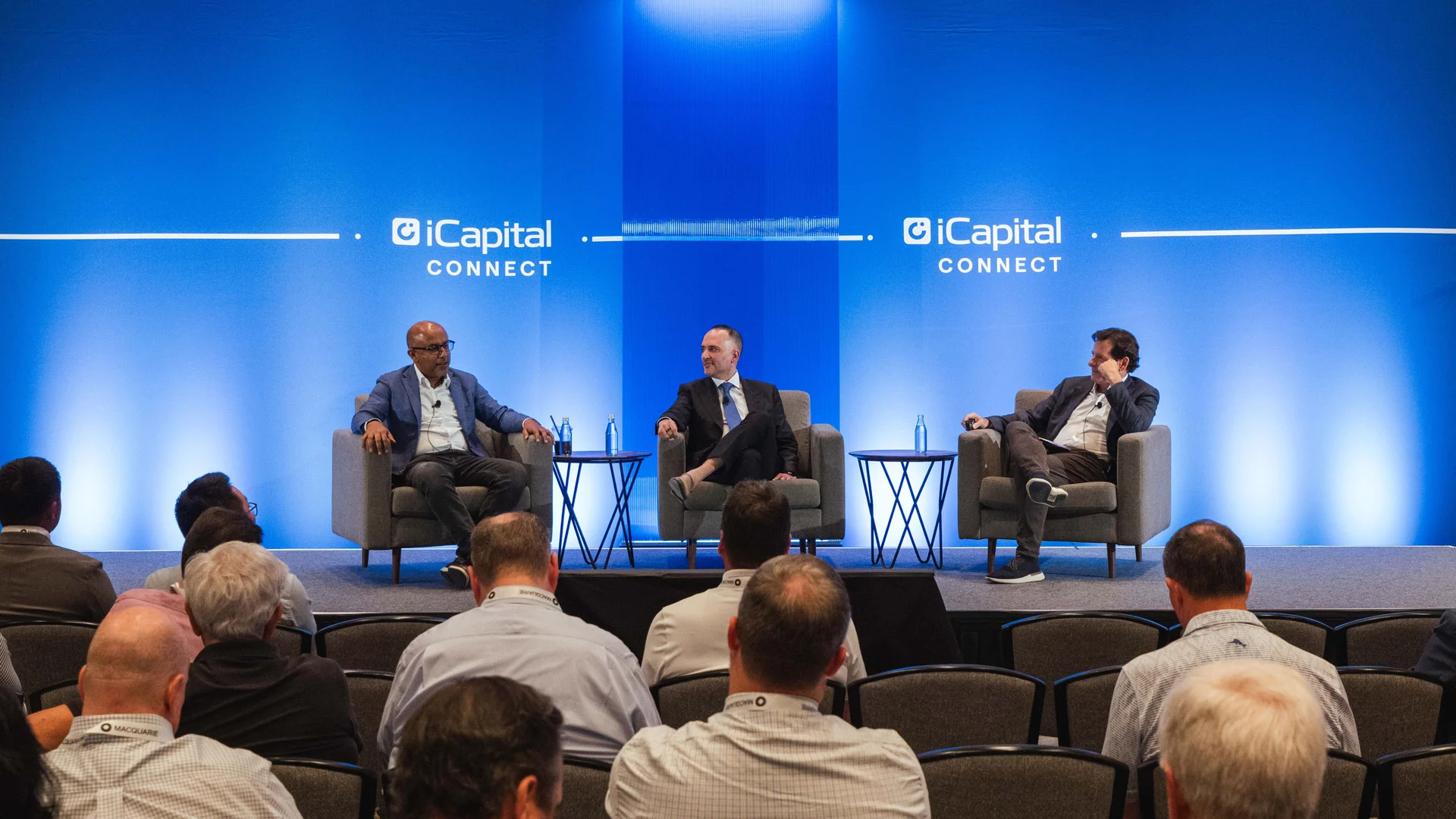
iCapital’s Nick Veronis, head of portfolio management, moderated a conversation with Monti Saroya, senior managing director and co-head of Vista Equity Partners’ flagship fund, and Michael Demissie, managing director and head of Applied AI at BNY. Together, they explored the rise of agentic AI, what it means for enterprise software, and why this transition is less about technology breakthroughs and more about trust, culture, and execution.
Why agentic AI is a different ball game
At its core, agentic AI represents an evolution of generative AI. While large language models excel at synthesizing information and responding to prompts, agents go further: they act.
As Saroya explained, agentic AI can be thought of as software users—digital workers that interact with enterprise systems the same way a human would. They log in, follow workflows, make decisions within guardrails, and execute tasks to achieve defined outcomes.
Demissie described how this concept is already live at BNY. The firm refers to its agents as “digital employees,” complete with logins, email addresses, KPIs, and governance structures. These agents aren’t theoretical or experimental; they operate in production environments, handling real workflows that once took significant human effort.
In other words, AI is no longer just a tool; it’s becoming labor.
Why enterprise moats still matter
With such rapid progress, it’s natural to ask whether smaller and more agile AI‑native startups will overtake established enterprise software providers. The panel’s answer was nuanced.
Saroya emphasized that enterprise moats are rooted in data, context, trust, and regulation. Mission‑critical systems from insurance platforms to financial infrastructure contain decades of proprietary data that have never been exposed to the public internet. That data can’t simply be scraped or replicated by a foundation model.
Equally important are security, auditability, and explainability. In regulated industries, every decision must be traceable. When a regulator asks how a conclusion was reached, “the model said so” is not an acceptable or legal answer. Enterprise software is built to satisfy those requirements, and that remains a powerful advantage as AI capabilities are layered on top.
Demissie echoed this from the perspective of a global financial institution. At BNY, scale and trust are not theoretical constructs but operational realities. Processing trillions of dollars in assets and payments requires absolute reliability. While that creates a strong starting position, it also raises the bar: clients increasingly expect the same speed, simplicity, and intelligence they experience elsewhere.
The message was clear. Incumbents can’t rely on their moats alone and they must modernize from within.
Cultural transformation is the hard part
Despite headlines about cutting‑edge models, both speakers agreed that technology is no longer the primary constraint, but adoption.
Demissie described this shift as a social contract between firms and employees. From the outset, BNY treated AI as a strategic imperative driven from the top. Nearly the entire workforce now has access to AI tools, with many already building custom applications.
Just as important, the firm has been transparent. Some tasks will be automated, and that reality isn’t hidden. Employees are encouraged to move toward higher‑value work as routine workflows are handed off to agents.
Saroya offered a parallel view from Vista’s portfolio, where adoption has varied even among engineers. Top performers tend to embrace AI quickly, while resistance clusters in the middle. The gap, he noted, isn’t technical skill, but belief.
Agents are expanding the market, not just efficiency
One of agentic AI’s most significant implications is economic. Traditional SaaS growth has been capped by seat counts, but agents remove that ceiling.
Unbound by headcount, agents enable usage‑ and outcome‑based pricing and unlock new markets—labor‑intensive services such as KYC, payments, research, and compliance once limited by human capacity. At BNY, Demissie noted that agents are already compressing workflows from weeks to hours, freeing teams for judgment‑driven work.
The software company of the future
Looking ahead, Saroya outlined how enterprise economics could shift. Traditional SaaS models depend on margins powered by human labor. Agentic models invert that structure: labor declines, while inference, the compute that enables agents to reason and act, becomes the primary cost.
The economics may look different, but margins can rise, growth can accelerate, and value creation can become more durable. The near‑term constraint isn’t software but infrastructure: compute, data centers, and power.
Would you put the genie back in the bottle?
Both panelists answered without hesitation: no.
Demissie framed AI as a societal superpower, capable of expanding access to healthcare, information, and expertise worldwide. Guardrails and discipline are essential, but the opportunity is too significant to ignore.
Saroya took a generational view. Knowledge work, he noted, is relatively new. If AI can absorb screen‑based tasks, people may be freed to focus on more meaningful problems.
Agentic AI, the panel concluded, isn’t about replacing humans. It’s about reshaping how work gets done, and for enterprises willing to lead that shift thoughtfully, the opportunity is enormous.
IMPORTANT INFORMATION
The material herein has been provided to you for informational purposes only by Institutional Capital Network, Inc. ("iCapital Network") or one of its affiliates (iCapital Network together with its affiliates, "iCapital"). This material is the property of iCapital and may not be shared without the written permission of iCapital. No part of this material may be reproduced in any form, or referred to in any other publication, without express written permission of iCapital.
This material is provided for informational purposes only and is not intended as, and may not be relied on in any manner as, legal, tax or investment advice, a recommendation, or as an offer or solicitation to buy or sell any security, financial product or instrument, or otherwise to participate in any particular trading strategy. This material does not intend to address the financial objectives, situation, or specific needs of any individual investor. You should consult your personal accounting, tax and legal advisors to understand the implications of any investment specific to your personal financial situation.
iCapital Markets LLC operates a platform that makes available financial products to financial professionals. In operating this platform, iCapital Markets LLC generally earns revenue based on the volume of transactions that take place in these products and would benefit by an increase in sales for these products.
The information contained herein is an opinion only, as of the date indicated, and should not be relied upon as the only important information available. Any prediction, projection or forecast on the economy, stock market, bond market or the economic trends of the markets is not necessarily indicative of the future or likely performance. The information contained herein is subject to change, incomplete, and may include information and/or data obtained from third party sources that iCapital believes, but does not guarantee, to be accurate. iCapital considers this third-party data reliable, but does not represent that it is accurate, complete and/or up to date. iCapital makes no representation as to the accuracy or completeness of this material and accepts no liability for losses arising from the use of the material presented. No representation or warranty is made by iCapital as to the reasonableness or completeness of such forward-looking statements or to any other financial information contained herein.
Securities products and services are offered by iCapital Markets LLC, an SEC-registered broker-dealer, member FINRA and SIPC, and an affiliate of iCapital, Inc. and Institutional Capital Network, Inc. These registrations and memberships in no way imply that the SEC, FINRA, or SIPC have endorsed any of the entities, products, or services discussed herein. Annuities and insurance services are provided by iCapital Annuities and Insurance Services LLC, an affiliate of iCapital, Inc. "iCapital" and "iCapital Network" are registered trademarks of Institutional Capital Network, Inc. Additional information is available upon request.
© 2026 Institutional Capital Network, Inc. All Rights Reserved.