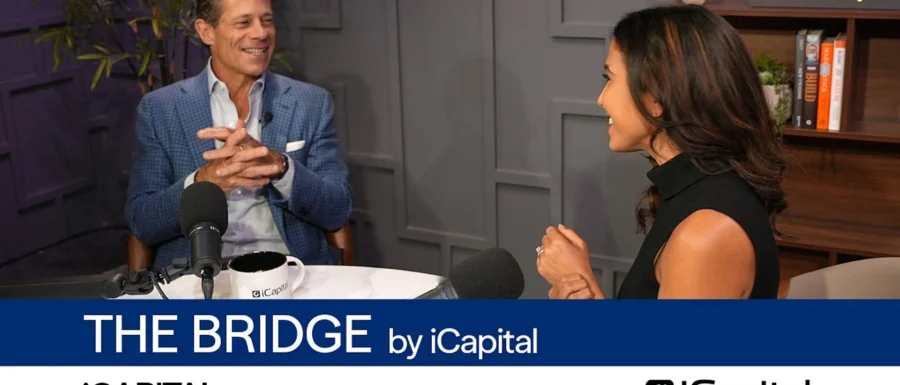
Together, they explore the rise of AI agents, the growing gap between AI leaders and laggards, and whether AI can become a meaningful driver of economic growth.
Chatterji explains why retraining may matter more than automation, why human judgment and relationships could become even more valuable in an AI-driven economy, and why traditional measures of productivity may be missing much of AI’s impact.
His central message: AI’s biggest impact will not be replacing people but creating new kinds of work we’ve never considered.
The Bridge Ep 018, Ronnie Chatterji, OpenAI – Transcript
Sonali Basak:
Welcome to the latest episode of The Bridge by iCapital. I am Sonali Basak. I am the Chief Investment Strategist at iCapital, and today I am joined by Ronnie Chatterji. He is the Chief economist at OpenAI, you might have heard of it, , and you have been there now about two years. You are the first chief economist at OpenAI. You have a career that spans academia, the government sector, the private sector. Why are you at OpenAI? I mean, why did a, why does a chief economist exist at OpenAI?
Ronnie Chatterji:
First, thanks for having me, Sonali, I appreciate it. It’s great to be here. When I first, uh, started talking to OpenAI about the job, my wife asked me the same question, you know, she said, what does a frontier AI lab need with an economist, you know, you understand you need people to build models, you need people to understand how to turn them into products, but why economics and why at a relatively early stage in the development of AI and ChatGPT, sort of the flagship product. I think it came down to the idea that we think AI is going to have a big impact on the economy. And there was a really sort of strong conviction inside OpenAI that we wanted to understand how and where. And they wanted to look at it from someone who had a perspective, both from academia who understand public policy, but also had been embedded in enterprises and thought about it from business perspective. And so, when they came to me with this idea, I said, uh, you know, is there a job description? And honestly, the answer was like, you write the job description and that’s when you know, I think that you’re in for a really wild ride.
Sonali Basak: [02:05]
Well, it’s kind of wild, right, because you’re now able to build a team. You had built a team from scratch. You brought in, you know, different viewpoints, like you said, public sector, private sector, and kind of deep thinking, deep research. You see that in the work that you’re putting out. So, what, how, how do you build this differently? How do you build a division that looks at the economy of the future enabled by AI rather than the economy as what it was?
Ronnie Chatterji:
The first thing I did is I talked to some other people who had worked in industry as chief economist. I don’t think there’s anything quite like OpenAI but it’s really useful to talk to other people who’ve been embedded in enterprises and use their economic reasoning and logic to try to help that organization. So, I talked to those folks, and I realized that advice was really valuable, but it wasn’t going to be exactly what I needed. And so then to start to think about the moment we were in and what kinds of answers people were looking for, and I quickly thought about three areas that I really think we need to provide answers. One is the job market and the future of work. I mean, you and I were talking about this before. AI is going to change the way that we work in so many ways, some that we’re already seen and some ways that we can’t even imagine yet. And I knew that any team I built would have to have a strong focus on understanding the future of work. The other piece was enterprise. You know, I’m a business school professor by heart. I love teaching MBAs. I realized that for AI to succeed, it was going to have to be adopted in organizations, in businesses. And if we didn’t understand that we were going to miss a big part of the picture. And so, I decided to put up a, a group that was going to focus on enterprise adoption as well. And the last piece, and this is really special for OpenAI, I realized there were going to be lots of questions that didn’t fit in the traditional toolkit. I wasn’t going to be able to do this job the way other chief economists had. So, we created a sort of another pod of, of people in my team to focus on the AGI economy, thinking about what economic questions really hadn’t even been asked yet, because we weren’t thinking about the world in the right way. We didn’t have the tools. And so those three pods kind of form the foundation of my team and how we approach the work.
Sonali Basak:
Okay, so we’re definitely going to talk about agents and workers.
Ronnie:
Sure.
Sonali:
We’re going to talk about the future of work. Before we get there, I want to have a little bit of a call out before and after because you closely worked with the CHIPS and Science Act.
Ronnie:
Mm-hmm .
Sonali:
And so, what is the before and after laying the groundwork from a government perspective for a, a meaningful technological build out in the United States? Fast forward to today. Where have we come and where have we not gone yet?
Ronnie Chatterji:
Well, when you study economics and you do a PhD, you’re really sort of bought into this idea that markets and incentives can be really useful. So, when I thought about how technology gets built, I always thought about the strength of entrepreneurs and innovators. The importance of deep capital markets, uh, a culture that celebrated innovation and trying new things. And we’ve had that in the United States for a long, long time. And when I got to government the first time around, I was really working off of that playbook. When I returned for my second tour of duty, the world had really changed. And I don’t think it was a Democrat, Republican thing. It was really a bipartisan consensus that some technologies were so critical. Some technologies were so important to national security. Some technologies had such high capital expenditure requirements that in areas of what you might call deep technology, it could be generative artificial intelligence, new forms of energy, quantum computing, synthetic biology. We needed a new playbook. And, uh, the CHIPS and Science Act was a big part of that in terms of building the semiconductor industry in the United States. What was interesting is I’d call some of my old professors up and I’d say, you know, how do we think about this? And a lot of the work that had been done on industrial policy supporting sort of domestic industries had been done in an earlier era. And people like me really hadn’t even studied that in graduate school. So, it was like a learning curve to figure out how to do that right. Um, we did have a lot of support from all kinds of folks in the business community and politics. And as you know, a lot of those efforts are continuing today. I think the measure of success of an effort like that is, does it continue across administrations? And it is. And two is, are we building more capacity to produce these critical technologies in the United States? And that’s happening too, when you look at the fab that’s being built all around the country. So those are the measures of success. Um, it’s still a lot, there’s still a lot of work to be done.
Sonali Basak:
Right, what are the biggest hurdles? Because you think about how far we come, and I think Wall Street does have this tendency to reduce everything into a series of numbers.
Ronnie:
Yeah.
Sonali:
$800 billion in CapEx this year. $1 trillion in CapEx next year estimated at least. And so, money alone does not fix this problem.
Ronnie Chatterji:
That that’s right. And I’ll use one number to illustrate the problem, which is 0%. That was what percent of the advanced semiconductors we were making before the CHIPS and Science Act as you think about going from zero up is really, really important for US National security. And I think that’s a consensus across the board. If you look at building dabs in the United States of America, the biggest challenge is preparing and training the workforce to succeed in those environments. Uh, we haven’t done this kind of manufacturing at the kind of scale that’s being contemplated for a long time. And so, for people to say, Hey, this is a job I want to invest in, I want to get trained for, you have to explain what the idea of the job is and what it means to work in a clean room and what a fab is. And once you do that, you have to make sure that opportunities exist where people live or somewhere they can commute to. These are all the challenges of building sort of a huge manufacturing industry in the United States. When you think about semiconductors, I’m confident we’re making a lot of progress, and it’s really due to a lot of people’s efforts. But glad to have played a small part in it.
Sonali Basak: [07:01]
It’s a good time to talk about your views on the economy, because if you look at the last year and a half, a lot of people will look at GDP and say, well, wait a minute, was GDP propped up a little too much by the AI build out?
Ronnie:
Mm-hmm .
Sonali:
Is that masking other problems in the economy actually? It relates to exactly what you’re talking about, because clearly the manufacturing build out has really been dominated by the AI CapEx boom.
Ronnie Chatterji:
CapEx for AI definitely played a role in supporting GDP over the last two years. You know, there’s been estimates ranging from like, you know, 25 or quarter, let’s say, you know, sort of a quarter of a percent let’s say, of sort of supporting GDP all the way up to 1%, depending on how you ask. And so big numbers and an important part of the story. I think it’s not atypical though, when you see these big build outs to support what could be a transformational technology. If you think, going back to telecommunications and the internet, that’s really what AI is here too. I think it’s not surprising that it’s playing a big role in GDP. And the other place to look at is the job market. And the job market’s been relatively strong. You know, I think despite a lot of predictions, the unemployment rate has stayed very low. Recent data looks like there might be a little bit of softening in key parts of the job market, but in general, with this kind of low unemployment rate, a lot of the predictions about that really haven’t come to pass. So, I think on those dimensions, the economy is strong. Uh, obviously people are watching parts of sort of what’s going to drive growth going forward, hopefully productivity from AI and looking at key parts of the job market, particularly early career people who are starting off their careers, um, in terms of seeing that will continue to, to recover.
Sonali Basak:
You know, it’s interesting, uh, a lot of people, when they looked at the AI boom, there was a lot of, um, apocalyptic predictions. I’ve gotten say, and to just to anchor the conversation, I’m not one of those believers personally. I don’t think that AI will decimate a job market so much as meaningfully altered in ways that people are not capturing it yet.
Ronnie:
Yeah.
Sonali:
Um, but to, to, for that to be true, there does need to be training.
Ronnie:
Yes.
Sonali:
Right, there does need to be an active effort by companies across the planet to make sure their workforces are set up for the jobs of the future. What do companies need to do?
Ronnie Chatterji:
Well, first, I agree with you that like, the way that work is changing is very different than you might see in the jobs numbers. I think a lot of folks, they look at AI and they say, wow, this is super powerful. It can do all these amazing things. It’s going to sort of negatively affect jobs right away. I think what’s actually happening is people are doing different kinds of work at their job. So, we have some research that shows that people are doing tasks that aren’t necessarily always part of their job description. If you’re a finance professional, you might be doing things in marketing, or it might be coding up a website. If you’re in design, you might be able to do some work that you know that you couldn’t do before using the tools. What’s happening underneath the hood of jobs is that work is changing. And I think that’s a much more realistic picture of where the economy is today. Some jobs are going to reorganize and have different kinds of tasks under the same job description. Some jobs demand will actually grow. You know, I think we tend to think if you’re exposed to AI, it’s bad for your job, not necessarily, right? If you lower the cost, if you want to produce a graphic design or a line of code, we might actually increase demand for that product or service, depending on elasticity and all the things economists worry about. So, I feel like that argument about AI exposure in the job market was already, um, was, was not complex enough to capture what’s actually going on. But however it affects the job market, whether it reorganizes jobs, increases demand, or automates other jobs, we’ll need retraining and new onboarding for people to get to new professions that’ll be created by AI. I think to do that, we need cooperation between government and business, you know,
Sonali: [10:21]
And schools.
Ronnie: [10:22-10:41]
And schools and educational institutions. I think it’s hard sometimes to forecast what the skills are going to be. So, I think what business can do is help to give a clear signal wherever they can to government, educational institutions. And our community colleges are really great at this about what they’re hiring for and what they need, and those skills and being able to support those workers when they come in to continue skill development is also really important. Those are the key things.
Sonali Basak: [10:42]
So, what does worry you about the job market as it pertains to AI?
Ronnie Chatterji:
It worries me when people are starting their career right now, getting a leg up in the job market, their first job. I think for folks who are more experienced, AI can be a real compliment to your expertise. When I think about how I look at economics now, how I study economics, it’s together with ChatGPT, I can ask the right questions. I can talk back and forth about questions that I’m thinking about. I can, uh, create artifacts, knowledge artifacts that I couldn’t do before much more quickly. But for my kids who haven’t yet studied economics at a high level, it’s a much harder question. And rather than asking ChatGPT for an answer, I want them to figure out how to think and how to learn. That’s the part that worries me most is how do we create the right kinds of incentives and environment for young people, those who are in school and entering the job market to get the skills and critical thinking they need to succeed. That’s the big challenge.
Sonali Basak:
Well, I’m hearing two things from you and as we speak. One is that there is kind of this cross-sectional expertise that’s being built as AI proliferates because the finance person might be doing marketing tools, might be doing more HR functions than in the past. But it’s also this idea of perhaps a more seniorized workforce than most companies would actually like and it’s because kind of those low lift jobs are being automated.
Ronnie Chatterji:
And if you’re a private equity, uh, professional, you’re a lawyer, you’re in a consulting firm, that structure of hiring sort of a new young analyst to train to be the next generation of leaders in your organization has been a really important part of how you build a great organization. And that’s the part I think I want to keep my eye on the closest. You know, there is some evidence that the early career job market might be softening, um, during the same time that we’re seeing the introduction of ai, the studies go back and forth on that, but that’s kind of the one area of the job market,
Sonali Basak:
Right, correlation is not causation.
Ronnie:
This is right.
Sonali:
What evidence do we have that actually newer, newer jobs, right? People right out of college are being impacted by AI. Are we, are we certain of that?
Ronnie Chatterji:
We’re not certain. There’s one paper, uh, by authors at Stanford I think is really well done called Canaries in the Coal Mine. It gets talked about a lot and rightfully so. That’s trying to control for some of these things that we might think about, you know, interest rates being higher, the post COVID economy. But even then, if you read the authors and what they write, and they’re very careful, uh, in this work and fantastic at what they do, they explain that you can’t eliminate all alternatives. And so, while you have that study, I think a lot of the other conjecture about the impact of ChatGPT on the early career market, it’s a little more correlational. It doesn’t mean that they’re not right. Doesn’t mean we shouldn’t keep studying it, but I wouldn’t say we had definitive evidence. When I see a result like that, I just sort of resolve to keep an eye on that part of the job market to figure out if I can learn something about the early career, it’s good not to dismiss that evidence out of hand. It’s also not good to anchor too heavily on it before we have more research and understanding.
Sonali Basak:
Right. And I imagine you care a lot about this space
Ronnie:
Definitely.
Sonali:
Given you’ve been a professor.
Ronnie Chatterji:
Oh, for sure. For me, I want to figure out the answer. I mean, I think the interesting thing for me being in an AI lab is I both have this interest in understanding where the technology’s going, but the impact, particularly the impact on students, is something I’ve cared about, you know, my whole career. So, I’ve thought a lot about that, and I talked to a lot of students even now about their job prospects and what they want to do with their lives.
Sonali Basak:
So, advice from Ronnie Chatterji, if you’re a graduating college today, what majors should you have?
Ronnie:
? Yes.
Sonali:
What are you supposed to be bringing to the job force with you?
Ronnie Chatterji:
So, I think that the first thing I try to tell folks is I have empathy for where you are. You know, I think as an economist or someone who lives in the markets, sometimes we might tend to be, you know, setting the numbers right away. And so, well wait a minute. You’re telling me you’re having difficulty with recruiting, but what about these jobs? What about this LinkedIn posting? What about the headline unemployment rate? As a human, that’s not what people want to hear, right? First, I think you have to empathize and say, look, what’s, what’s the problem you’re trying to solve? Are you trying to get a summer internship? Are you trying to get that next job? Are you thinking about graduate school? Are you thinking about training for that next thing? Figuring out where people are is number one. Number two is then getting people some assurances that, like when I was in that stage, like none of us had it all figured out. You know, I come from a South Asian family, as you probably know, and like sometimes there was a stereotype that, you know, you can either be an engineer or a doctor. And that came from like a very specific heuristic that in many cases wasn’t always true. There are different kinds of engineers, they’re different kinds of doctors. And my parents and your parents and others didn’t have a perfect forecast of which kinds of specialties would be most in demand. They generally thought those were good professions. And I think that’s the kind of best evidence we’d have today. I think it’s still important to study STEM the way you think about sort of formal logic. And computer science is going to be useful in everything you do. So many people who majored in engineering don’t actually work as engineers, but if you ask them, was it valuable when you studied as an undergrad engineer, almost all of them will say yes. And I think that’s an important lesson that your major isn’t always dictating what you do. The second thing, and I see a lot of schools focusing on this more, let’s not forget the human skills. It was only a decade ago that we wanted every kid to learn how to code and we put this enormous emphasis on STEM education. Really positive and smart but we probably were over sort of calibrated away from some of the really important humanities. And I think we’re seeing a return to that. And many people are talking about that human skills are going to be at a premium. We’re still going to need leaders. You’re still going to need learn how to delegate. With AI, and I’m sure you see this with your own work. The question is not can I do it? It’s what should I do? And that’s ultimately a question that needs to be answered for the individual, and that’s what humanities prepares us to do.
Sonali Basak:
Yeah, it’s interesting that you, you mention that because people talk about this a lot as it pertains to the wealth management industry, the private equity industry, the banking industry. And what I keep saying is, listen, we’re having so much information thrown at us. AI is making life a lot easier, but it’s also giving me too much.
Ronnie:
Yes.
Sonali:
And it’s the human judgment. I’m finding that is becoming a huge premium, real advice that you can trust.
Ronnie Chatterji:
I see investment advisors, you know, sort of the successful ones, like leaning in this direction. You know, the human element of the job is so important to what they do. I talk to my friends who work with advisors and they often say, you know what? I don’t need someone to give me sort of tips on stocks or investing strategy. I need a therapist for my money . And what does that mean, right? They want a relationship. And so, a lot of that other information is going to be close at hand for your advisor and for you. But what do you want? You want someone who’s going to walk you through the big decisions in your life that you and your partner might be facing. Decisions that, yeah, there might be a, a better and a worse answer, but ultimately, they come down to your personal goals and your plans. And having someone walk you through that with a human element can be really, really important.
Sonali:
Okay so, this is so interesting to me. So, if you were thinking a financial therapist
Ronnie:
Yes.
Sonali:
Is kind of the advisor of the future. Yes. The investment advisor of the future, then is open AI kind of like the diary?
Ronnie Chatterji:
Well, it’s really interesting. I know a lot of financial advisors who use open AI tools, and I know a lot of people who are investing who also use it. If those diaries can create shared artifacts, they can be really useful. Imagine if I actually forced to write down my goals. My financial advisor has asked my wife and I to write down our goals a bunch of times. We don’t always listen. Imagine if with the help of ChatGPT.
Sonali:
also guilty, right?
Ronnie:
Right, guilty as charged. But you know, with ChatGPT, maybe we’d have an easier time taking a live conversation with my wife and I making that into a transcript and really deducing, what do we really want? Where do we want to go with our lives? If our advisor can then have access to that, and there’s lots of ways you can think about that, he might be able to help us better rather than spending an hour on the phone trying to get that out of us. So, I think that shared memory, that diary could be really useful. And I do think the future of a lot of intermediaries, people who are in the middle of important transactions, like financial advisors, is going to be emphasizing their human element. That’s the advantage. That’s the wedge. That’s where the margin’s going to come from.
Sonali Basak:
It’s interesting. AI has definitely changed the financial community over the last decade and much more. So, after the advent of ChatGPT, but you know, from where you sit, what are the industries, the kinds of jobs that are going to be most impacted by AI, what are the trends that you’re watching that more people should be aware of?
Ronnie Chatterji:
I think there’s one area where I think actually AI is going to create more demand and more jobs. I’ll talk about that first. And I’ll talk about some of the jobs that are probably going to be sort of more likely to be exposed to AI, uh, in disruptive ways. On the, on the positive side, healthcare and education are two areas where I think we’re going to see a lot more demand for human beings. Why do I think that as societies get wealthier more prosperous, they historically have spent more on healthcare and education. If you look at most small towns in America, like where I grew up, the major industries and job, uh, providers are eds and meds; education and healthcare, a local hospital, K to 12 education, a community college, if you’re lucky enough to have one in your community. And I think as we get more prosperous, if AI pays a dividend in that way, as AI helps us with some of the other work in the economy, there’ll be more emphasis on lowering class sizes, having more people in healthcare delivery to help you through difficult treatments, having harder conversations, preparing you for difficult decisions. That’s going to be really important even as technology becomes more capable. On the other side, I think jobs that are remote that don’t involve working with other individuals, jobs that have, uh, rote tasks involved, AI’s really good at these kinds of things. And so, it’s not going to happen right away, but those are the jobs that I expect to be the most exposed AI in a way where AI could actually do the whole job. Any job where humans are in the loop, that humans are really necessary, those are jobs where were more likely reorganized around humans, not necessarily be replaced.
Sonali Basak:
So, it’s interesting, uh, I hadn’t thought about this before, but what you’re describing is a bit of an economy that could be more local, hyper-local. Would you agree with that?
Ronnie Chatterji:
A lot of education, healthcare is delivered locally. I think there’s a lot of reasons for that. You want to know your person who’s doing that. You want to know your teacher lives in your community or your doctor, that you can find them at the farmer’s market or whatever it might be. And so, I think if you think about locally provided services like healthcare and education, we want them to be close to where we are. We want it to be served by community members that we know that share our values, and we want to have sort of a higher touch environment with lower class sizes, more attention from healthcare providers. These are all things we spend more on as we get richer as countries. And you see this across the world. So those are areas I think that will be really important.
Sonali Basak:
So, you mentioned that we spend more as we get wealthier as a country, but what about the K-shape? You know, I mean, it’s assuming that you have a economy that uniformly gets richer.
Ronnie Chatterji:
This is, this is, and this is the number one thing I think policy makers should think about. When I think about my own, uh, concerns. I think a lot about that critical thinking, preparing young people. That’s important. But this idea of are the gains from AI sort of distributed, uh, across the board? This is the number one question for policy. And I think having worked in government at a time when we were dealing with lots of different economic challenges, I worked, um, in the aftermath of the financial crisis the first time and the second time was after COVID. What was really helpful is having sort of a government policy toolkit that had automatic stabilizers. When there’s downturns in the economy, we increase the level of benefits. That’s really important. Monetary policy’s incredibly important in that. So, I would say to folks, we do have a lot of things in the toolkit to deal with economic shocks and disruptions. The challenge will be if some of these things are concentrated in particular industries or geographies, and this is where retraining and targeted assistance to those communities and industries really matter, that’s going to be the best way we can deal with a potential K-shape scenario.
Sonali Basak:
You know, you mentioned you were in the government post-GFC, post-COVID.
Ronnie:
Yeah.
Sonali:
I mean, I’m wondering if you see any parallels to this moment to almost kind of those crisis level responses. Right. The administration is very focused
Ronnie:
mm-hmm .
Sonali:
on AI policy, but I’ve got to admit, I would like to see it move faster.
Ronnie Chatterji:
I think that a lot of the things that kick in that help us during sort of economic downturns are already in place and we see them when those things happen. I remember when I was in government and you saw the unemployment rate rise, right? Right now, it’s very low. Then you see the benefits increase, right? On something like SNAP or extending unemployment insurance. So, I think some of those things are in place and they get revved up if you have economic challenges. In other ways. I think you see this government governments all around the world thinking big about, okay, how are we going to manage, um, the benefits from AI and also if it does create challenges in the job market, how are we going to help people? And so that conversation is starting at our organization, OpenAI, we released an industrial policy blueprint that supports that. Um, a lot of other folks are talking about this too. So, I think there’s a high-level conversation, but I do think we shouldn’t overlook the tools we have in fiscal and monetary policy that are, that have been pretty effective, uh, historically as well.
Sonali Basak:
Yeah. On a macro level, um, it’s interesting, I wanted to jump to the Federal Reserve
Ronnie
mm-hmm .
Sonali:
And particularly as it pertains to the Fed, the task forces
Ronnie:
mm-hmm . Mm-hmm .
Sonali:
If you were on the Fed task forces, you know, whether it’s productivity and jobs or whether it’s around the inflation frameworks or the data, I mean, all of those areas seem to have really meaningful tie-ins to artificial intelligence
Ronnie Chatterji:
For sure. I mean, first it’s a, you know, obviously it’s a great idea to have these task forces and great people are on them. And so,
Sonali Basak:
What would you be on?
Ronnie Chatterji:
? I’d probably, you know, here’s what I think, I think the thing I’m most interested in is the measurement of AI in the economy. It’s very wonky, but I think it’s very important. And I think the, uh, chairman Walsh and the rest of the governors agree with that. We need to figure out where AI is showing up, where it’s going to drive productivity. Some of the data is fit for purpose and others isn’t. And if there are better ways, both to harness the kind of data infrastructure that we have, this is one of the reasons, you know, we released enterprise signals today to give people a sense of here’s what’s going on with enterprises adopting AI. That’s data that the government doesn’t have that we can put out into the world. We released it on the consumer side, and we say, Hey, here’s data that no one else has. And so, we try to play our part by putting that data out the world. I’d like to help build a stronger measurement infrastructure across all labs and working with the government so we could basically be able to have more real time indicators of AI’s use in the economy. The regional Feds play a great role in this. You’ve seen great work out of the Richmond Fed, the St. Louis Fed, the Atlanta Fed on this in particular. They’re also a key part of the system. So, I, if I was, you know, working on those task forces and advising them, I’d focus, like the nerd I am on, on measurement.
Sonali Basak:
So, I’m very passionate about measurement as well. I, I would heavily agree that the tools we use to measure the economy today are really outdated and do not reflect the current realities of AI either. So, you know, what, what do you think specifically, you know, if there’s a way that, um, officials can move towards such that they’re measuring the economy better, what should they be looking at today that they’re not?
Ronnie Chatterji:
There’s, there’s two things I think are really important. One is one where they have some data, but it could be better. And the other I think is an area where we just need a whole refresh. We are doing lots of firms’ surveys, asking organizations, Hey, are you using AI? And those surveys are really effective. You can get thousands of firms to respond. And if the Fed is asking, usually people answer. But I think we’re in a world where the breadth of adoption matters less than the depth of adoption. I might answer than my organization’s using ai, but without knowing how intensely I’m using AI, what I’m using it for, how I’m thinking about the return on investment, we miss a really important margin of adoption. It’s very hard to do. But that’s something I think that we could really benefit from in terms of measurement, looking at depth. The second area is more wholesale, but the whole AI jobs discussion is really based on this O*NET classification that is in the Department of Labor. It’s a way to categorize jobs, but even the biggest proponents, even the folks who use this in all their research say we could do better. The way people work right now doesn’t necessarily map those tasks in O*NET and we’re missing something when we look at AI exposure and O*NET tasks, and so that’s an area where I feel like we could do a lot of good work from the bottom up and maybe create a whole new measurement infrastructure to think about how we measure work. I mean, Sonali, as crazy as it sounds like, I mean, we as economists don’t understand enough about work, and I think we need to do more measurement in that area.
Sonali Basak:
No, I, I completely agree. And, and not just work, but what does productivity actually mean?
Ronnie:
Yes
Sonali:
I think one thing that really stresses me out actually about AI is that the way we look at productivity is very incomplete. Yes. I think a lot of, uh, financial analysts, what they’ll do is simply measure productivity as it pertains to AI in terms of margins
Ronnie:
mm-hmm .
Sonali:
In terms of output but this idea of output per worker doesn’t always work in this new economic construct.
Ronnie:
This is Right.
Sonali:
How do you think about productivity?
Ronnie Chatterji:
Well, two, one, I think it doesn’t, it doesn’t pick up a lot of the important angles of ai to your point. I mean, one of the things we track or, or think a lot about in my team is consumer surplus. An economics term. Consumer surplus happens when I plan my kid’s birthday party with AI or make a financial decision with ai. A lot of things we’re doing, especially on the free services, we, you know, we have so many free users on ChatGPT, that’s just creating pure surplus. That doesn’t show up in GDP. When I save time doing something, using ChatGPT, it doesn’t show up in GDP. And so, there’s so much value to consumers that will never show up in productivity statistics. And I think that’s a really important dividend from technology that needs to be accounted for. The second piece is productivity usually takes a little bit longer to show up, uh, from transformative technologies. I mean, we’ve been doing a study of like looking at historical technologies, the railroad, the semiconductor, the internet. Um, when you look at those things, even these transformative technologies, it takes a while to show up in the stats. So, the other thing is, can we get better real-time indicators of productivity? You saw this in a recent St. Louis Fed report where they were talking a little bit about firms in that district and those firms reporting some productivity increases. And, you know, it was more on a case-by-case basis, but I thought it was really interesting as early indicators, and I’ve sort of done some work to understand where that’s coming from. I think that’s probably where we’ll see some of the important data before it shows up in the general productivity.
Sonali Basak:
And it’s really, it’s funny, the emotional response of stress stressing me out. It’s because you look at all these Wall Street reports that come out and productivity is simply measured kind of just by GDP
Ronnie:
yes. But if you know that CapEx is fueling that GDP, then are you really measuring the productive capacity of AI?
Ronnie Chatterji:
And this is the challenge. And AI’s going to have lots of uses that we don’t even know as a general-purpose technology. It could do a lot of things and we’re not going to capture that. The other thing I’ll say is, um, you know, AI is, it’s being used in enterprises could create entirely new business models that we haven’t thought about. These are all things that won’t be captured in the statistics. Um, AI is, is already being used by a lot of folks. And measuring productivity at the worker level to your other point is also really tricky.
Sonali Basak:
Well, also the thing that it doesn’t account for at all is where there can be improvements in quality of life.
Ronnie Chatterji:
That’s also true. Yeah, if you think about, I mean, my ability not to ask AI about decisions in my life or think about someone who doesn’t have, um, sort of access to those things, I think a lot about, I travel a lot for the job. And so, I’ve been to maybe 12 different countries as the chief economist of OpenAI. And there are places where they don’t have a small business consulting firm that’s affordable. And so, if you’re a small business trying to, um, grow, you need to get advice from somewhere. And now this advice appears in a way it never was before. People focus a lot on AI challenging expertise, that’s important, but in many places it’s the first expert. The first expert, anyone had to consult on how to grow their business or whether they should go to the doctor or how to think about a difficult family relationship. And so having those experts in, in AI is actually creating a big dividend in other parts of the world in ways we might not think about. And that’s an important benefit to AI that doesn’t get worked in,
Sonali Basak:
You know, you mentioned kind of this idea of small business formation
Ronnie:
mm-hmm.
Sonali:
and new businesses forming. I’m wondering how sustainable you think that is?
Ronnie:
mm-hmm.
Sonali:
Uh, how, how many businesses can continue to form? Um, I think about this in the context of, you know, what I think is one of the most important things lately, which is the price of tokens.
Ronnie:
Yeah.
Sonali:
If token costs are generally declining
Ronnie:
mm-hmm .
Sonali:
…across the industry
Ronnie:
mm-hmm . yes
Sonali:
Generally speaking, uh, who does, who wins in that scenario?
Ronnie:
Yeah.
Sonali:
The enterprise, the consumer that’s adopting it?
Ronnie Chatterji
We have studied entrepreneurship extensively in my team because, you know, that’s my research areas has been in entrepreneurship for a long time. I’m really interested about how new technologies make the entrepreneurial process easier. We are finding the entrepreneurs are using AI in a variety of different ways. Uh, we released report a couple months ago where we kind of showed using our classification system, what they’re using it for. Marketing ends up being the number one use. I think for a lot of people who are starting a company, they may have a great idea, they may able to, uh, provide a service that, uh, is really valuable. But how do you tell people about it? And for some people, they’re natural marketers, but a lot of people, they might have hired someone for that or get some assistance, but now they can use AI and particular ChatGPT to add that to the skillset. So, you become someone who has one skill and adds another to help grow your business. That’s really important. And this is obviously happening at a time contemporaneously where you’re seeing a huge increase in entrepreneurship overall. It’s not clear whether ChatGPT or any other AI tools causing that, but it’s happening at the same time, which mean more entrepreneurs can use it.
Sonali Basak
That was going to be my next question. How are we sure that it’s AI that’s enabling this?
Ronnie Chatterji:
These things are happening at the same time, but I think, um, a more careful study would have to be done to think about whether AI is causing those new ventures to found. I think what I’m seeing in the data is people can do more now, right? So, if you’re a solopreneur, you could do marketing, you could do finance, you could build the first website in a way you couldn’t before. And that might help you scale faster. And I think about folks who are in parts of the world or parts of this country where they might not have the depth of expertise in that market. They might not be able to hire somebody right away. This helps them accelerate. This is how I think about it.
Sonali Basak:
I I also think about this in the context of, you know, small business formation is so important to the American dream.
Ronnie:
Yes.
Sonali:
Um, what it used to account for what, two thirds of all new job formation.
Ronnie:
That’s right. Yeah.
Sonali:
But with AI, is it the case that you would see an, a necessary tick up in small business formation that also is accompanied by a tick up in jobs?
Ronnie Chatterji:
Small businesses often are where jobs are created, as you mentioned. So, we get more small businesses, and they hire folks as their businesses expand. You could definitely see that.
Sonali Basak:
But do they hire less people because AI could help.
Ronnie Chatterji:
This is the margin we’ll to watch if businesses are growing longer or scaling faster with fewer employees, right, the question is when they get to new markets, when they, when they commercialize their product, is that when they hire? So, we have to see as these small business grow, what that looks like. It’s, I also think large firms are going to also take a lot of advantage of AI. I think when we teach it in business school, there’s this narrative, okay, disruptive technology startups win, incumbents lose. But the thing I always remind my students is those CEOs of those incumbent companies, they went to business school too. And they are thinking a lot about how do I avoid being the dinosaur in that case study? How do I adopt AI faster, better, smarter, to make sure that some startup doesn’t eat my business? So, I’m really looking forward to seeing, yes, these amazing startups, but also how some of the bigger existing organizations leverage AI across the organization.
Sonali Basak:
Right. I, I think I wonder about that a lot. We’re seeing all this new business formation, but at the very end of the day, are they going to compete in an, in a world where scale has mattered so much? Just because the businesses are forming, it doesn’t mean necessarily that they will last the test of time.
Ronnie Chatterji:
It depends on the market. I, I would, I would think if there’s a market where you need a huge capital expenditure and a lot of financing to compete harder for a small business to do that, you know, we have, you know, deep capital markets in the US a venture capital market, but it’s difficult. But if in other areas, especially locally provided goods and services, uh, you can see a huge margin where these small businesses could compete. So, depends on market selection. And this goes to the question, AI can do a lot, but you have to choose where you want to play. And, uh, and that’s really important for small business owners.
Sonali Basak
So, uh, I want to, I think this is a great time to, to touch on your most recent paper.
Ronnie:
Sure.
Sonali:
Because we’re talking about work, the future of work, how work, how jobs are changing. But what about not people, what about agents?
Ronnie Chatterji:
, I tell people all the time, the agents are showing up to work. And I feel like, you know, I read all these books, uh, in my earlier years about every generation you had to write a book. And I feel like I need to write the book about generation agents now because agents are now part of the workforce. And you see this in our data that so many companies are leveraging agentic tools to get work done. And what our paper shows is there are firms on the frontier, we call them kind of the top 10% firms, they are using more tokens per user. So, we standardize it in that way. They’re using more tokens per user than the median firm by about 8 x. That’s a huge gap that’s just grown over the last five months since we did this report before. And if you see that gap growing from two x to eight x, that tells me that the frontier firms are really doubling down on using agentic use cases. You’ll see in the future, whether that translates into new business opportunities, higher ROI, but right now that usage gap is growing and something to watch. That’s the big headline from enterprise signals released today.
Sonali Basak:
Could you give us a, an example, right? Give us a visual of what that really looks like. Where has agentic workforce really made a dent in an industry?
Ronnie Chatterji:
Coding is really the first use case. You saw this in late 2025 and we saw this inside OpenAI. What was kind of interesting about our work is we actually studied OpenAI as a test case. And you saw in sort of the development and sort of coding applications that agentic tools took off in a big way. Being able to write code, complete code check code, then it kind in January, it pivoted. And we saw this in open AI where our entire research and engineering groups were pretty much fully saturated using agentic tools. If you look at the percentage of the tokens, they produce all agentic sort of sources. It took maybe about four months from January to April for finance, from marketing, for legal, for the people org, to get to that same level. And I look at that and I just say, wow, four months and the less the organization, the less technical parts of the organizations are now at the frontier. And I think if you’re wi, if you’re listening to this and you’re thinking about your own enterprise, think about that gap between when your technical people are using agentic tools to your less technical people and shrinking that gap is probably really important to getting the benefits from AI.
Sonali Basak:
Right? If I’m working at a company today, am I going to be competing with an agent?
Ronnie Chatterji:
Or you could be using an agent to compete with someone else. I think that’s the way to think about it in another firm. I think one thing to think about is like, we tend to think about the agents as substitutes, right? For humans. I can think about it as a complement too. And in terms of how we think about technology. So, I might be spinning up multiple agents to do the work, uh, that I couldn’t do before, would’ve taken me days to do. What do I do with my extra time? I might be able to spend more time with my team. I might be able to spend more time on higher level tasks. That’s the big question. And right now, I think that’s why AI has been more of an accelerant and a complement in organizations rather than sort of creating massive disruptions in the job market.
Sonali Basak
Yeah, it’s interesting ’cause when you think about the agentic workforce, we’re really just getting started
Ronnie Chatterji:
For sure. And there’s a lot to learn. And, and this is also why we got to watch the data every month. I always tell people, I don’t try to make a lot of predictions. Like we know what’s happened so far with AI capabilities. They have gone up into the right. If you look at all the evaluations, these are the, the tests we put models, uh, through to measure their effectiveness. They’ve just increased dramatically even since the time, I’ve been at OpenAI. But the impact on jobs and enterprises, you see that in a different way. And I think what you’re seeing now is a lot more adoption, a lot more depth of adoption in the frontier firms that we document today in the enterprise signals report. But now we’re going to see what the returns to the adoption is, and that’s kind of going to be the story of the next quarter.
Sonali Basak:
Right. Because it’s not clear yet. You know, we went, you were talking about January to now, you went from a culture of token maxing and agents just burning tokens to a, a sense of discipline in most CFO’s office.
Ronnie:
Yes.
Sonali:
Right, so, um, how does that mindset shift in terms of how token spend is allocated, uh, really ripple through the way people think about workforce and agent solutions?
Ronnie Chatterji:
I mean this, if you read the history of sort of technology and enterprise, this happens with almost every new enterprise technology innovation. You think about the advent of cloud, all of a sudden, you turn, uh, into an allocator. You’re thinking about how do I allocate my resources to different parts right here with AI, it’s the same thing. Which models do I run for which tasks? Uh, what are the most efficient models? Ours compete very well on those dimensions, but I feel like there’s a world where now we’re going to be allocating tasks to models and thinking about how much intelligence do I need to do this task? And I think you’re going to see that kind of discernment in a way that’s going to align efficiencies across organizations. That’s what CFOs are looking for. Uh, and that’s where we think like a family of models is really useful.
Sonali Basak:
Ronnie, at the very end of the day, you know, what, what does this all boil down to for you? What is the most important economic question of today as it pertains to ai?
Ronnie Chatterji:
To me, it is whether AI will drive economic growth. That’s really what we’re looking for. If we drive economic growth, we can raise living standards. And if we do the right things in other parts of our society, everyone will benefit. Um, that to me though, is the big question with AI is will it drive growth? And you’re seeing a lot of promising signs so far. I think one I keep an eye on, if you double click, is scientific discovery and innovation. Economists have long focus on innovation, creation of new products and services as a driver of economic growth. And if AI can accelerate the innovation process in semiconductors, in life sciences, in manufacturing, that’s going to have a positive benefit on growth in the places where firms are doing that. That’s what I’d watch.
Sonali Basak:
Great. From a macro perspective, we’re sitting here in a place where we’ve seen this kind of really strong synchronized rebound, right?
Ronnie:
Yep.
Sonali:
So, what keeps you up at night?
Ronnie Chatterji:
I think two things keep me up at night. One is I think there’s going to be a capability overhang, and there still is between how great AI is and the things that I know it can do or, you know, it can do versus how actually people use it. And I think that is going to create a mismatch in expectations. You know, I found when I talk to enterprises that there’s just such a difference between what the models could do for that worker versus how they’re using it, and lots of reasons why they’re not sort of revealing that gap or, or, or closing that gap. So that’s one thing I think is really important. That is going to be a rate limiter unless we can close that gap. And the second thing is, do we make sure that the gains from AI, the dividends from AI are shared broadly? That is really the thing that keeps me up at night. It’s very difficult to do. It’s reflecting on my career in government, in business and academia, and I know it’s going to take sort of a, a, a large team effort to make sure that goes right. And that’s, that’s what I think about the most.
Sonali Basak:
Ronnie, it’s been so great to talk to you today. I know we’re just touching the surface of a, a really large change in the economy. That is Ronnie Chatterji, he’s the Chief Economist at OpenAI, and you’ve been watching The Bridge by iCapital.