
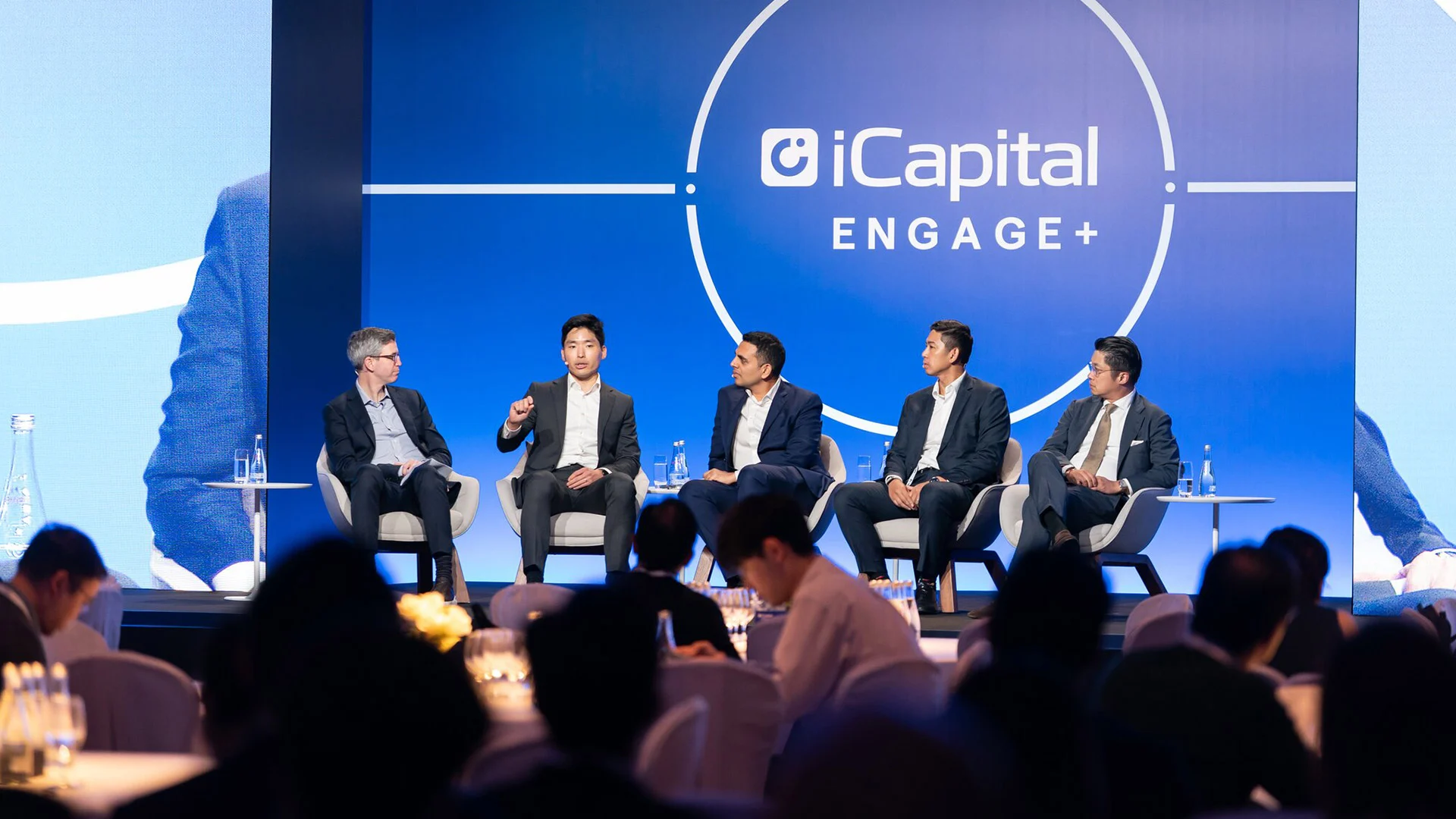
The 2026 iCapital Engage+ Hong Kong brought together over 300 clients and partners, including 200 wealth managers, to explore the evolving role of alternatives in modern portfolios. The agenda spanned geopolitics and the macro environment, private equity, credit, infrastructure, secondaries, and the technology that scales them.
1. EXECUTION IS THE NEW BINDING CONSTRAINT
iCapital’s Head of Asia Pacific, Tuan Lam, opened the event by reframing the private-markets conversation. The question, he argued, is no longer whether to allocate to alternatives but how to do so at scale and repeatably, across an entire book of clients. As Lam put it, “most clients don’t just struggle with the why, but they also sometimes struggle with the how to invest.” With demand largely settled, the friction has shifted to execution, operations and portfolio construction, and it is education, access and operating infrastructure that increasingly determine who converts conviction into invested capital. The firms that lead the next phase, he suggested, will treat private markets as an operational discipline rather than a product to be sold.
2. ASIA IS NOW THE CENTRE OF GRAVITY FOR PRIVATE WEALTH
Tuan Lam also spotlighted Asia as the fastest-growing pool of wealth globally, and the region where private-markets adoption has the furthest to travel. He noted that allocations remain well below institutional levels, a gap he framed as opportunity rather than caution. The point was underscored by the latest BCG wealth report, which shows Hong Kong edging past Switzerland as the largest international cross-border wealth centre. Asia’s entrepreneurial, first-generation wealth relates naturally to private markets, Lam suggested, and the direction of travel is unambiguous. For global managers, he added, a credible regional presence is fast becoming a prerequisite rather than a differentiator.
3. THREE STRUCTURAL TAILWINDS ARE RESHAPING PRIVATE MARKETS
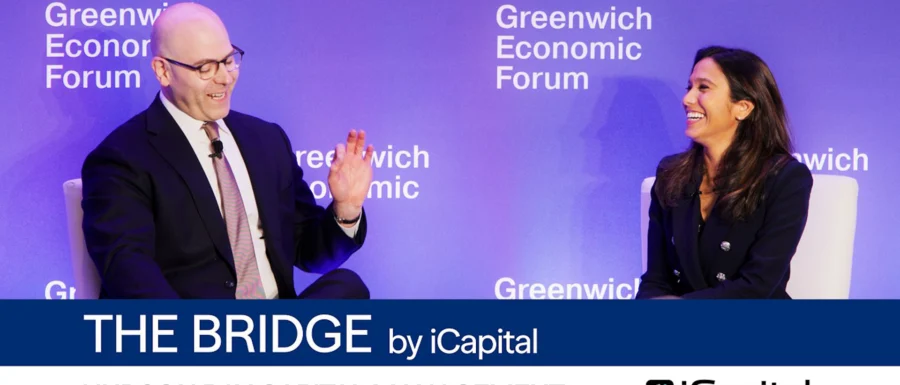
In a reflective fireside, iCapital’s outgoing Head of International, Marco Bizzozero, outlined three structural tailwinds he believes can each double or triple the industry’s assets. The first is a rethinking of public versus private markets; as he put it, “public markets are not a reflection of real economies anymore,” with most value creation now occurring before IPO. The second is an “industrial renaissance” of capital expenditure across AI infrastructure, energy and defence that public balance sheets cannot fund alone. The third is the under-allocated individual investor, sharpened by a retirement wave of a billion people by 2030. Tuan Lam reinforced the first point, noting that over 90% of the real economy now sits in private markets.
Watch the Highlight Video
4. A MULTIPOLAR WORLD IS DRIVING SHARPER DIVERGENCES
iCapital’s Chief Investment Strategist, Sonali Basak, provided an update on the macro backdrop, explaining that the firm’s call for “meaningful divergences headed into 2026” had played out more sharply than expected, across rates, growth, earnings and fiscal paths. Drawing on data from 3,500 wealth and 1,200 asset-management firms, she highlighted higher-for-longer bond yields, a breakout in global manufacturing and an increasingly AI-concentrated wave of capital investment as the key themes driving markets. The preceding geopolitics session saw Colonel Tim Collins and former Swiss Armed Forces chief Thomas Süssli argue that the rules-based order has given way to a multipolar one. Their counsel for investors was that trust is becoming the new currency, and that resilience, supply-chain diversification and an assume-breach cyber posture are now table stakes.
5. PRIVATE CREDIT’S SELL-OFF SENTIMENT-DRIVEN, NOT DUE TO FUNDAMENTALS
In one of the discussions on private credit, iCapital speakers and panellists alike cautioned against reading too much into recent volatility. Sonali Basak characterised the redemptions as “sentiment-driven and not fundamentals-driven,” with software and AI exposure concentrated in a 2021-era vintage rather than systemic. Marco Bizzozero added a sense of proportion, noting that the roughly $2 trillion of leveraged loans drawing the headlines sits within a far larger market that is mostly institutional and investment-grade, and that individual investors’ allocations had largely come out of equities rather than fixed income. Panellists from Pantheon, Golub Capital and Lord Abbett observed that first-quarter markdowns chiefly reflected spread widening rather than impairment. Manager selection, they agreed, now matters more than ever.
6. PRIVATE EQUITY ALPHA NOW DRIVEN FROM OPERATIONS
Moderating the private equity panel, iCapital’s Head of International for iDirect, Edwin Chan, framed the discussion around a single question, “how do you move from beta to alpha?”, as multiple expansion fades. The panellists agreed that operational value creation now does the heavy lifting, with several putting the operational share of returns as high as 80 to 90% and describing how they deliberately model multiple contraction and lean on AI. They observed that private equity in Asia is maturing, with buyouts leading for the first time and founder-owned businesses changing hands at single-digit multiples, and made the case for buying smaller assets and selling into larger players. The reset, they suggested, rewards disciplined underwriting and operational toolkits over financial engineering.
7. INFRASTRUCTURE HAS BECOME A BET ON AI AND ENERGY
James Keady, iCapital’s Head of Strategic Business Development, led a dynamic global panel exploring how infrastructure is being reshaped by the rapid rise of AI and the resulting surge in power demand. The conversation highlighted a shift toward investing in the critical systems that enable this transformation, from energy networks to data centres supporting hyperscalers, while challenging outdated perceptions of regional risk. Asia emerged as a region of growing stability and scale, while Europe’s energy transition was reframed as a defining strategic priority with far-reaching implications. The panel also underscored infrastructure’s growing relevance for wealth investors, offering a compelling blend of income, resilience, and long-term growth. Across the discussion, a consistent theme of discipline stood out: in a market defined by strong tailwinds, success will depend on careful structuring, thoughtful capital deployment, and a focus on sustainable opportunity sets.
8. EVERGREEN GATES ARE A FEATURE, NOT A FLAW
The conversation on evergreen structures felt notably more mature this year, with panellists agreeing that periodic gating is a feature rather than a flaw. iCapital’s Chief Operating Officer, Jeff McGoey, outlined what scaling these vehicles demands: frequent NAVs, careful redemption and liquidity management, and reporting that, as he noted, “is, in fact, marketing” because it runs continuously. The aim, he emphasised, is to deliver institutional-quality returns without the institutional administrative burden. External managers reinforced that evergreens suit long-term investors rather than those seeking a liquidity valve, and that scale and operational intensity are prerequisites. For advisers, the message was to match client expectations to the underlying assets’ hold periods and to treat liquidity as the result of sound portfolio design.
9. SECONDARIES HAVE GONE FROM LAST RESORT TO CRUCIAL PORTFOLIO TOOL
In a discussion on liquidity, secondaries emerged as a structural portfolio tool rather than a distress-sale mechanism. iCapital’s Sam Williams, a portfolio manager for iDirect Private Credit, moderated a panel featuring representatives from StepStone, Goldman Sachs, JP Morgan and Lexington Partners. Panelists pointed to record secondaries volumes and increasing adoption of the asset class, while industry data continues to indicate historically low loss rates and all-weather characteristics, despite market penetration remaining at approximately 2%. Mark Oliver, iCapital’s Head of Client Solutions Australia, highlighted the firm’s investment in Tangible Markets, a technology-enabled secondary adviser, describing it as extending the platform from “informed access to private markets to informed exits.” Wealth managers can monitor positions, model potential pricing and sell stakes, including gated evergreen ones. The wealth channel will follow institutions in treating access to secondary markets as a rebalancing tool.
10. TECHNOLOGY DETERMINES WHO SCALES
A recurring theme across the operational sessions was that technology determines who can scale. iCapital’s Chief Product Officer, Bekka Marrs, framed the choice for wealth managers starkly: either “hire your way out” with large internal teams and a high cost-to-serve, or get the infrastructure right from the start. The harder problem, she argued, is that stitching together point solutions eventually breaks down at scale; what’s needed is end-to-end technology across the lifecycle. Head of Business Management and Operations for APAC, Tim Lee, captured the firm’s guardrails as “run fast, break nothing,” while Chief Operating Officer Jeff McGoey contrasted low-stakes errors with the far higher stakes of hallucinated returns. The endpoint, McGoey explained, is an investor-centric model approach in which advisers are “selling a goal to a client.” Education, as ever, remains the connective tissue throughout.
For more information on iCapital Engage+ Hong Kong, or to register your interest in future iCapital events, please contact [email protected].
- BCG Wealth Report, Global Wealth Growth in an Era of Reordering | BCG, May 2026
This material has been provided to you for informational purposes only by iCapital, Inc. and/or one of its affiliates including Institutional Capital Network, Inc. (collectively, “iCapital”). This material is the property of iCapital and may not be shared without its written permission. No part of this material may be reproduced in any form, or referred to in any other publication, without express written permission of iCapital. This is not intended as, and may not be relied on in any manner as, legal, tax or investment advice, a recommendation to employ a specific investment strategy, or as an offer to sell, a solicitation of an offer to purchase, or a recommendation of any interest in any fund or security. Security products and services are offered through iCapital Markets LLC (a registered broker/dealer, member FINRA and SIPC), Institutional CN (Europe) – Empresa de Investimento, S.A. (registered with CMVM), iCapital Hong Kong Limited (licensed by SFC) and iCapital SG Pte. Ltd (licensed by MAS), all affiliates of iCapital. Registrations and memberships in no way imply that FINRA, SIPC, CMVM, the SFC or MAS have endorsed any of the entities, products or services discussed herein. Financial products made available by iCapital Markets LLC, Institutional CN (Europe) – Empresa de Investimento, S.A., iCapital Hong Kong Limited and iCapital SG Pte. Ltd. may be complex and/or speculative and are not suitable for all investors. iCapital Advisors, LLC is an investment adviser registered with the Securities and Exchange Commission and acts as an adviser to certain privately offered investment funds.
iCapital Hong Kong Limited is licensed for Type 1 (Dealing in Securities) and Type 4 (Advising on Securities) regulated activities (SFC CE No: BTM925) under the Securities and Futures Ordinance, and is regulated by the Securities and Futures Commission. It is a private company registered in Hong Kong under Business Registration number 74237275 and its business address is One International Finance Centre, Suite 2105, 1 Harbour View Street, Central, Hong Kong.
iCapital SG Pte. Ltd. holds a CMS licence for dealing in capital markets products under the Securities and Futures Act, and is regulated by the Monetary Authority of Singapore. It is a private company registered in Singapore (UEN: 202237416C) and its business address is 23 Church Street #09-07, Capital Square, Singapore 049481.
iCapital Hong Kong Limited and iCapital SG Pte. Limited are exempt from the requirement to hold an Australian financial services licence under the Corporations Act of Australia in respect of certain financial services they provide to “wholesale clients” for the purposes of the Corporations Act of Australia, and they do not hold such a licence. iCapital Hong Kong Limited is regulated by Securities and Futures Commission of Hong Kong under the laws of Hong Kong and iCapital SG Pte. Ltd. is regulated by the Monetary Authority of Singapore under the laws of Singapore. The laws of Hong Kong and Singapore differ from the laws of Australia. Any financial services provided to any person by iCapital Hong Kong Limited are provided pursuant to ASIC Instrument 24-0967 and any financial services provided to any person by iCapital SG Pte. Ltd. are provided pursuant to ASIC Class Instrument 23-0827.
“iCapital” and “iCapital Network” are registered trademarks of Institutional Capital Network, Inc.
© 2026 Institutional Capital Network, Inc. All Rights Reserved.