Investment Outlook
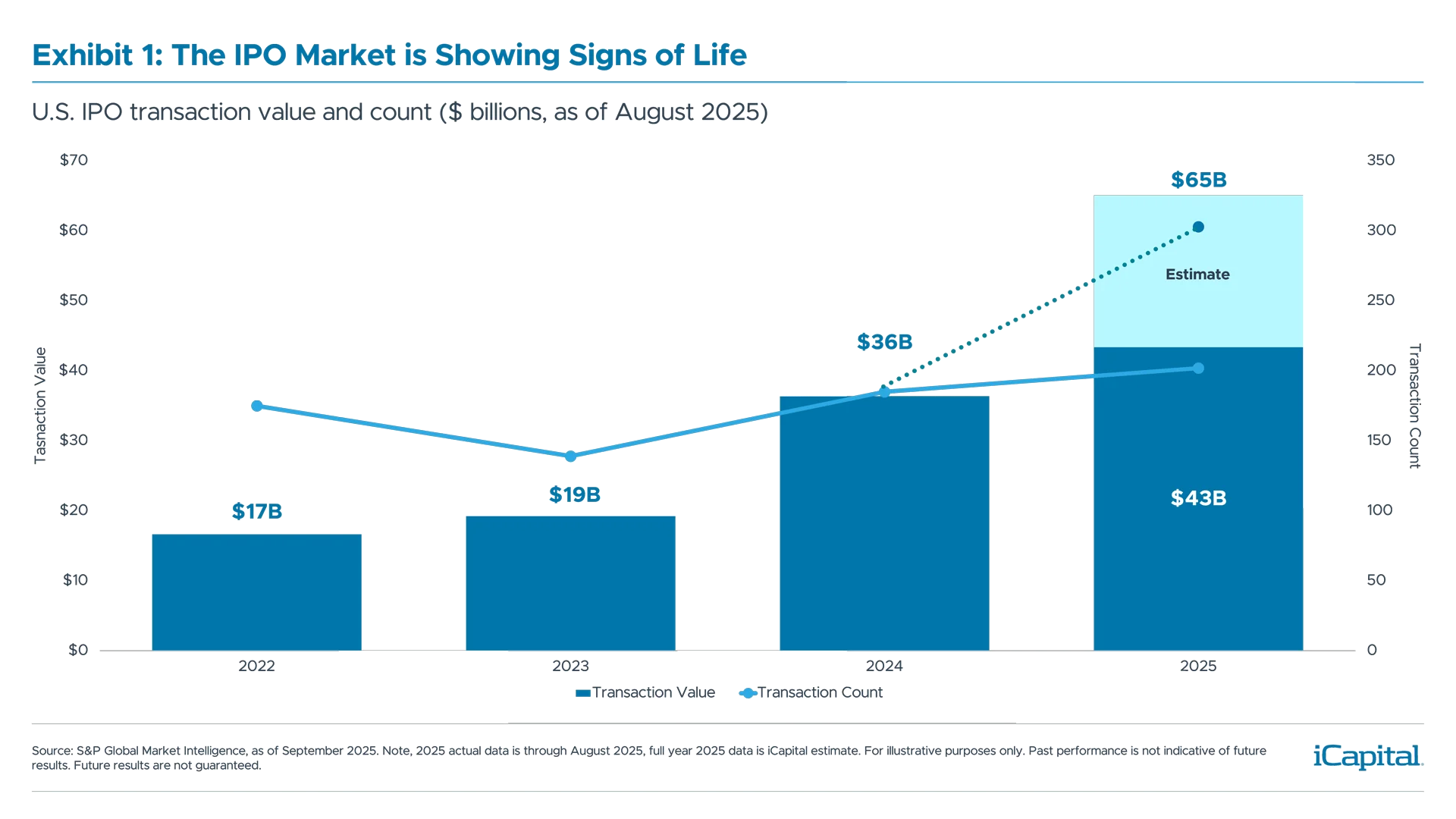
A growth equity investment strategy offers exposure to efforts focused on scaling businesses with an aim to exit via an IPO or strategic sale. The health of the IPO market is a leading indicator for growth equity as it is often the most lucrative exit path. That said, U.S. IPOs have raised $43 billion through August 2025 and are on pace to exceed $65 billion for the year, which would be an 80% increase from 2024. Halfway through 2025, the number of IPO transactions is largely flat compared to the full year 2024. Roughly 200 transactions have priced raising more capital compared to 2024, pointing to larger, higher-quality deals (all references to IPO data is based on Exhibit 1). This is relevant for growth equity as it occupies the middle ground between venture capital and buyout. The boundary lines are hard to see however, the category has evolved into much more than an intermediate private investing approach. A typical growth equity fund will invest in profitable companies that have proven business models and growing customer sets – the types of companies that can often seek an IPO exit.
Not only would a healthy IPO market be a tailwind for growth equity, but some managers tend to hold positions beyond an IPO exit. As a result, growth equity managers are often able to capture significant company growth, typically in excess of a 10% run rate, and sometimes beyond 20%.
 Recent Market Trends

Growth equity assets have experienced a steady increase over the last 15 years. As the private markets expand, more companies are operating private for longer. Within this context, there has been a notable trend of high growth companies staying private for longer that arguably would have otherwise would have gone public 10-20 years ago. Consequently, there is investor desire to access to some of these larger and faster growing private companies. Despite a difficult post-pandemic fundraising environment – as valuations for growth-stage investments reset – the asset class has increased its role across private equity with roughly 20% share of total assets (Exhibit 2).
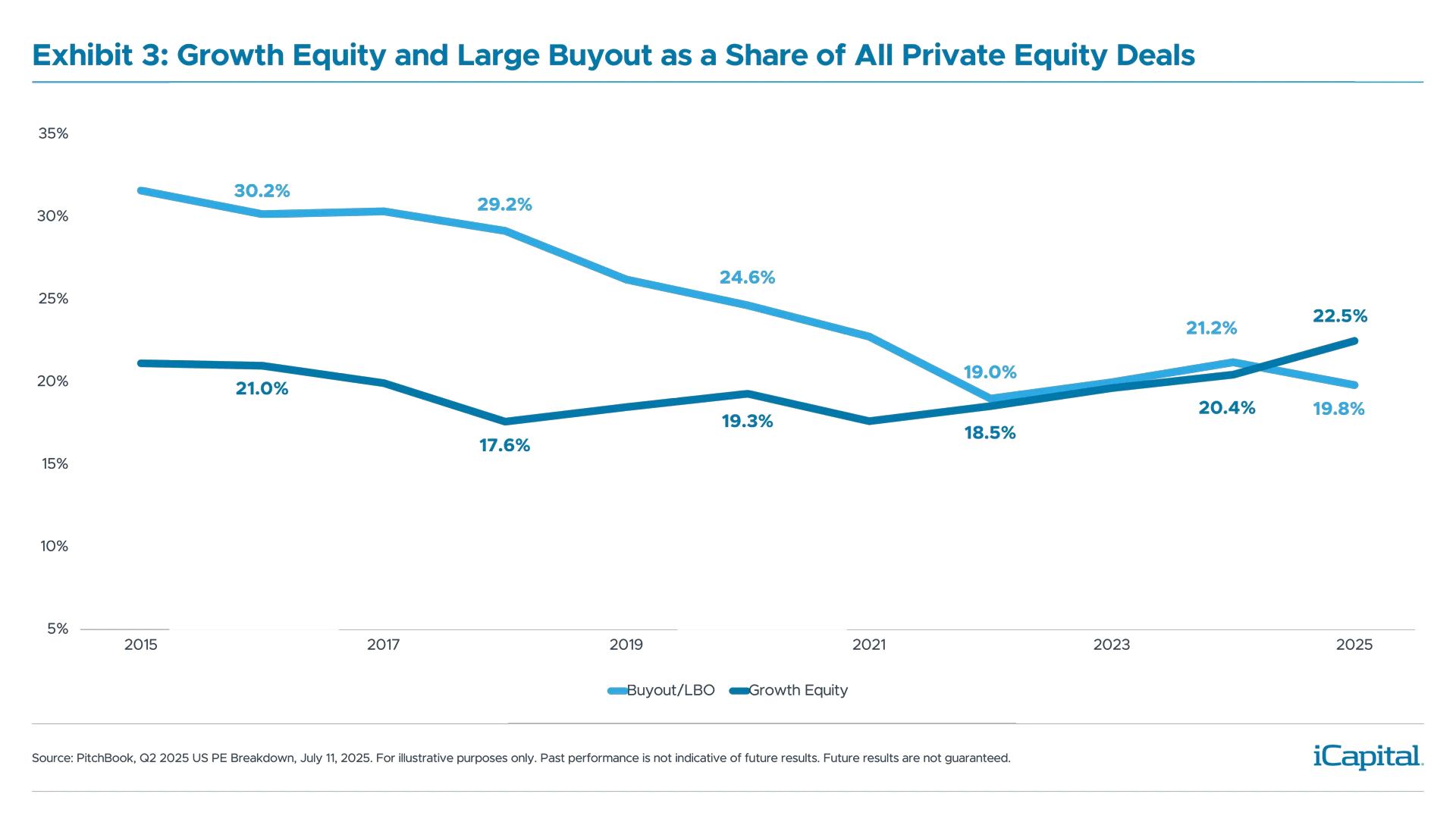
 In terms of deal flow, growth equity has increased its share of private equity deals to 23%, surpassing buyout. Moreover, growth equity is on track for its largest share of private equity deals since 2013 (Exhibit 3). This has been due to the trend of more public-to-private transactions where growth equity managers have an opportunity to unlock value though hands-on growth or profit improvement strategies that would be otherwise difficult in the public markets.
The uptick in deal activity shows that some companies are more comfortable with valuations. This could set the stage for outperformance over the medium/longer term due to a thawing path to realizations, presenting a path for sponsors to monetize pent up unrealized value.
 Industry Focus: Software

Growth equity managers often look for opportunities in companies that are at or near cash-flow positive with an opportunity to generate excess return by growing the business, often by unlocking product distribution and/or scaling technological innovation. With this strategy, some managers have a vertical focus based on industry expertise in areas such as software or health care.
In software, the recent valuation reset positions the space for an uptick in activity. Public market valuations (5.0x forward revenue, Exhibit 4) are below ten-year averages and presents pricing opportunities. Many software companies have grown larger by taking on private market capital, suggesting a sustainable period for larger and higher-quality IPO.
 Software tends to be one of the first industries to test the IPO waters – and is one of the biggest sectors for large cap private equity buyout – due to durable revenue and high margins and cash flow. More recently, the strong after market performance of recent IPOs should be a basis for a strong software IPO pipeline.
Publicly-traded software companies have a renewed focus on efficient growth. This balance in both revenue growth and margin expansion could allow software companies to unlock incremental value and multiple expansion—ideal conditions for growth equity exits. The Meritech Software Index is seeing median ARR growth of 15% with the median rule of 40 at 34%, arguably in a “sweet spot” for software.1
Performance Snapshot
Exhibit 5: Growth Equity Has Been a Steady Performer
| Strategy | 5-year | 10-year | 15-year |
| Buyout | 16.4% | 14.4% | 14.8% |
| Growth Equity | 14.6% | 12.8% | 12.4% |
| Private Capital | 13.7% | 11.8% | 12.5% |
| Venture Capital | 11.5% | 10.3% | 11.6% |
Source: Bloomberg Index Services Limited, Preqin, iCapital Alternatives Decoded, with data based on availability as of Mar. 31, 2025. For more information, refer to Additional Information and Index Definitions. For illustrative purposes only. Past performance is not indicative of future results. Future results are not guaranteed.


Additional Information:
Exhibit 5: Buyout proxied by Preqin Private Equity Buyout Index. Private Capital proxied by Preqin Private Capital Index. Growth Equity proxied by Preqin Growth Equity Index. Venture proxied by Preqin Venture Capital Index.
Exhibit 7: IPO data is based on U.S. exchange-listed IPOs that have begun trading and with market caps of at least $25 million. We exclude closed-end funds, unit offerings, and SPACs. The iCapital IPO Activity Barometer is a leading measure designed to offer forward-looking insights into underlying trends in U.S. IPO activity. It draws on seven key factors that have historically provided reliable signals of IPO activity going back to 2001: 1) Valuations, 2) Yields/Rates, 3) Volatility, 4) Drawdowns, 5) Business Conditions, 6) Investor Sentiment, and 7) CEO Sentiment. Given the indicator’s structure, the focus should be on overall trends rather than short-term fluctuations or specific levels at any given time.
INDEX DEFINITIONS
Preqin Private Equity Buyout Index: The index covers closed-end funds captured in the broader Private Capital index including funds/strategies listed as Buyout, as defined by Preqin.
Preqin Private Capital Index: The index covers closed-end funds captured in the broader Private Capital index, as defined by Preqin.
Preqin Growth Equity Index: The index covers closed-end funds captured in the broader Private Capital index including funds/strategies listed as Growth, as defined by Preqin.
Preqin Venture Capital Index: The index covers closed-end funds captured in the broader Private Capital index including funds/strategies listed as Early Stage, Early Stage: Seed, Early Stage: Start-up, Expansion/Late Stage, Venture (general), as defined by Preqin.
END NOTES
- Meritech Analytics, Company Filings and S&P Capital IQ. Data as of September 2025.
IMPORTANT INFORMATION
The material herein has been provided to you for informational purposes only by Institutional Capital Network, Inc. (“iCapital Network”) or one of its affiliates (iCapital Network together with its affiliates, “iCapital”). This material is the property of iCapital and may not be shared without the written permission of iCapital. No part of this material may be reproduced in any form, or referred to in any other publication, without express written permission of iCapital.
This material is provided for informational purposes only and is not intended as, and may not be relied on in any manner as, legal, tax or investment advice, a recommendation, or as an offer or solicitation to buy or sell any security, financial product or instrument, or otherwise to participate in any particular trading strategy. This material does not intend to address the financial objectives, situation, or specific needs of any individual investor. You should consult your personal accounting, tax, and legal advisors to understand the implications of any investment specific to your personal financial situation.
ALTERNATIVE INVESTMENTS ARE CONSIDERED COMPLEX PRODUCTS AND MAY NOT BE SUITABLE FOR ALL INVESTORS. Prospective investors should be aware that an investment in an alternative investment is speculative and involves a high degree of risk. Alternative investments often engage in leveraging and other speculative investment practices that may increase the risk of investment loss; can be highly illiquid; may not be required to provide periodic pricing or valuation information to investors; may involve complex tax structures and delays in distributing important tax information; are not subject to the same regulatory requirements as mutual funds; and often charge high fees. There is no guarantee that an alternative investment will implement its investment strategy and/or achieve its objectives, generate profits, or avoid loss. An investment should only be considered by sophisticated investors who can afford to lose all or a substantial amount of their investment.
iCapital Markets LLC operates a platform that makes available financial products to financial professionals. In operating this platform, iCapital Markets LLC generally earns revenue based on the volume of transactions that take place in these products and would benefit from an increase in sales for these products.
The information contained herein is an opinion only, as of the date indicated, and should not be relied upon as the only important information available. Any prediction, projection, or forecast on the economy, stock market, bond market, or the economic trends of the markets is not necessarily indicative of the future or likely performance. The information contained herein is subject to change, incomplete, and may include information and/or data obtained from third-party sources that iCapital believes, but does not guarantee, to be accurate. iCapital considers this third-party data reliable, but does not represent that it is accurate, complete and/or up to date, and it should not be relied on as such. iCapital makes no representation as to the accuracy or completeness of this material and accepts no liability for losses arising from the use of the material presented. No representation or warranty is made by iCapital as to the reasonableness or completeness of such forward-looking statements or to any other financial information contained herein.
Securities products and services are offered by iCapital Markets, an SEC-registered broker-dealer, member FINRA and SIPC, and an affiliate of iCapital, Inc. and Institutional Capital Network, Inc. These registrations and memberships in no way imply that the SEC, FINRA, or SIPC have endorsed any of the entities, products, or services discussed herein. Annuities and insurance services are provided by iCapital Annuities and Insurance Services LLC, an affiliate of iCapital, Inc. “iCapital” and “iCapital Network” are registered trademarks of Institutional Capital Network, Inc. Additional information is available upon request.
©2025 Institutional Capital Network, Inc. All Rights Reserved.